
Most bottling projects are specified from the filler backwards. The filling machine gets the accuracy figure, the capper gets a torque range, the labeler gets a container sample, and the quotation closes. Then the bottles leave the labeler and pile up at the end of a conveyor, because nobody planned what happens next. That gap is where a line loses the output it was bought for. Secondary packaging line integration is the work of connecting everything after primary packaging, from the labeler outfeed to a stacked pallet, as one system with one owner.
Runtech's own turnkey project process page names the failure mode directly: buyers who assemble a line from several vendors find that "between machines nobody owns the seam, and a missed handoff becomes your production delay." The same page sets out the eight-stage delivery sequence described in section 7. The equipment descriptions below come from the secondary packaging and line integration category page and its conveying and inspection subcategory.
1. Where primary packaging ends and secondary packaging begins
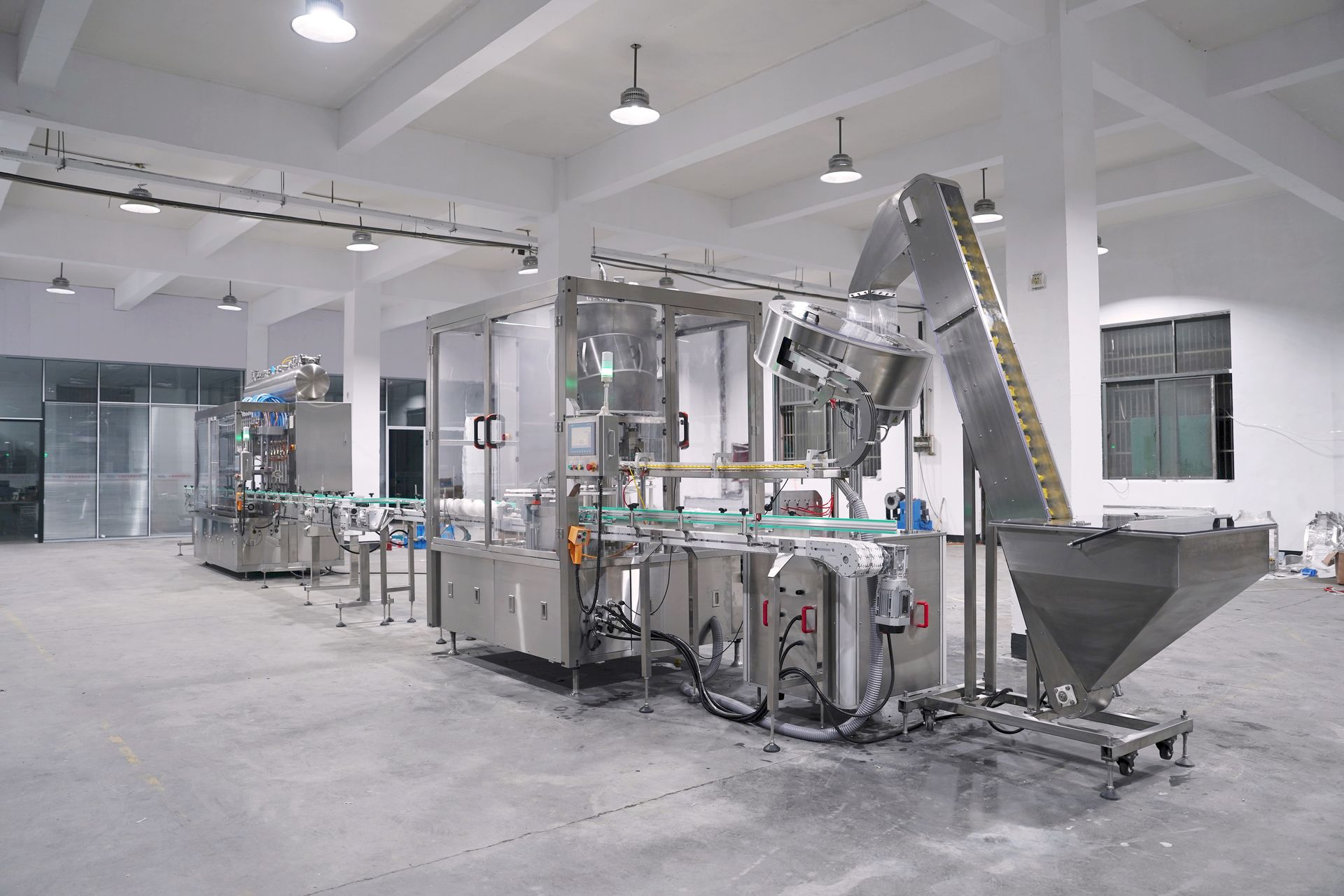
Primary packaging touches the product: the bottle, the closure, the label, and for some products the sleeve or wrap that carries the print. Secondary packaging takes the finished, labelled container and groups it for distribution. On Runtech's category page the scope is stated as "from primary container filling to final pallet loading," connecting liquid filling, capping, labeling, case packing and shrink wrapping into one automated system.
The boundary matters because the two halves are bought and judged differently. A filler is judged on fill accuracy at a rated speed. A secondary packaging line is judged on whether a full pallet leaves the end of the line at that same rate, hour after hour, with no manual intervention at the transfer points. A line can hit its filling speed and still miss its shipping target if the case packer cycles more slowly than the filler, or if an operator has to square up cartons by hand.
Two subcategories sit under this section of the site. Both belong on the layout drawing: conveying and inspection equipment and the bottle unscrambler and infeed turntable. The first moves and checks containers between stations; the second keeps the infeed supplied at a controlled rate. Both are integration hardware, not optional extras.
2. The station sequence from labeler outfeed to pallet
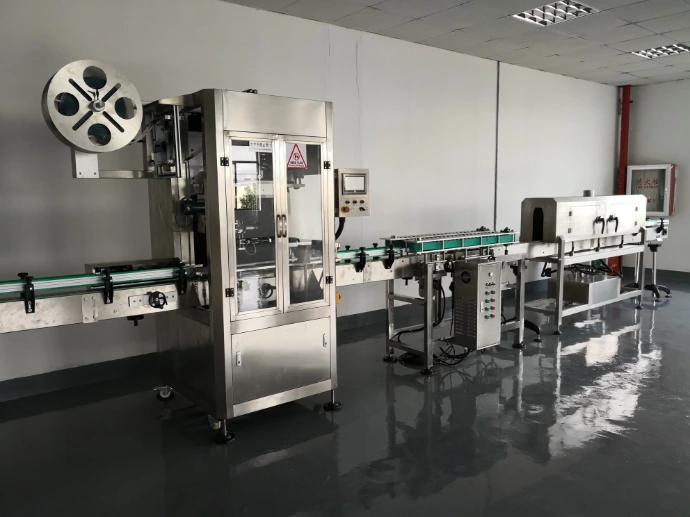
A secondary packaging line is a sequence of handoffs. Each station has a rated cycle, a format change procedure and a way of telling the station upstream that it is ready for the next container or the next group. The table below sets out the order used on the Runtech category pages.
| Station | What it does | What to fix before it ships |
|---|---|---|
| Conveying and inspection | Moves bottles between stations and checks fill level, cap and label | Sensor positions, reject logic, VFD speed range, belt material |
| Case erector | Forms flat carton blanks into open cases | Case blank dimensions, glue or tape method, magazine capacity |
| Case packer | Groups bottles and loads them into cases | Pack pattern, top/side/wrap-around or robotic pick-and-place, cycles per minute |
| Cartoner | Loads product into cartons for retail-ready packs | End-load or horizontal format, leaflet insertion, closure type |
| Shrink wrapper / tunnel | Bundles groups or applies sleeve film | Film type, tunnel temperature profile, bottle geometry |
| Palletizer | Stacks finished cases onto a pallet | Pallet pattern, layer count, stretch wrap, discharge position |
Not every line needs all six. A low-speed daily chemical line may run case erecting, packing and manual palletizing. A beverage line at higher output needs buffering, wrap-around case packing and automatic palletizing to keep up. The category page describes the full version as using "intelligent conveyor buffering, robotic pick-and-place packers, wrap-around case packers, and automatic palletizers to eliminate bottlenecking and manual intervention," built on "centralized PLC controls, line-wide sensor synchronization, and customizable line layouts."
Equipment catalogues use a long list of names for these stations: case packer, case erector, cartoning machine, end load cartoning machine, top load case packer, side load case packer, tray packer, robotic case packer, bottle drop case packer, horizontal cartoner, box conveyor and end of line packaging. They are different names for the same procurement decision, which is why a line specification should name the station and its rated cycle rather than list a machine by catalogue title.
3. Buffering and speed matching decide the real output
A filling machine's rated bottles per minute is not the line's rated bottles per minute. The case packer works in cycles, the cartoner in cartons, the palletizer in layers, and each of those has a different unit of output. Conversion between them is where projects go wrong. An existing Runtech article on liquid filling machine industry applications documents lines ranging from 8 BPM to 55 BPM; at either end of that range, the back end has to be sized against the same number, not against a generic "automatic packaging" label.
Accumulation is the usual answer. Buffer conveyor between stations lets a fast filler keep running while a case packer finishes a cycle, and lets the case packer continue briefly if the labeler stops for a roll change. The conveying and inspection page specifies sanitary modular conveyors with stainless steel frames and variable frequency drives, so the belt speed can be trimmed to match the line rather than running at one fixed rate. The capping line layout article covers the same problem from the front end: infeed and outfeed space, and the distance between stations, are layout decisions that have to be made before the machines are ordered.
Three numbers belong in the specification. First, the sustained output of the slowest station, not the peak output of the fastest one. Second, the buffer capacity in containers or in seconds of runtime between each pair of stations. Third, the recovery time after a downstream stop: how long the line takes to clear accumulated product and return to steady state. Without those, a quotation can claim a line speed that no combination of the listed machines can hold.
4. Put inspection between stations, not only at the end
Inspection is cheapest before the case is closed. Once a bottle with a low fill, a missing cap or a skewed label is packed and palletized, correcting it means unpacking a case or reworking a pallet. Runtech's conveying and inspection equipment is described as combining "sanitary modular conveyors with automated online quality check modules," built with "high-speed vision sensors, and automatic pneumatic reject arms," checking fill level, caps and labels as bottles move between filling, capping and labeling stations.
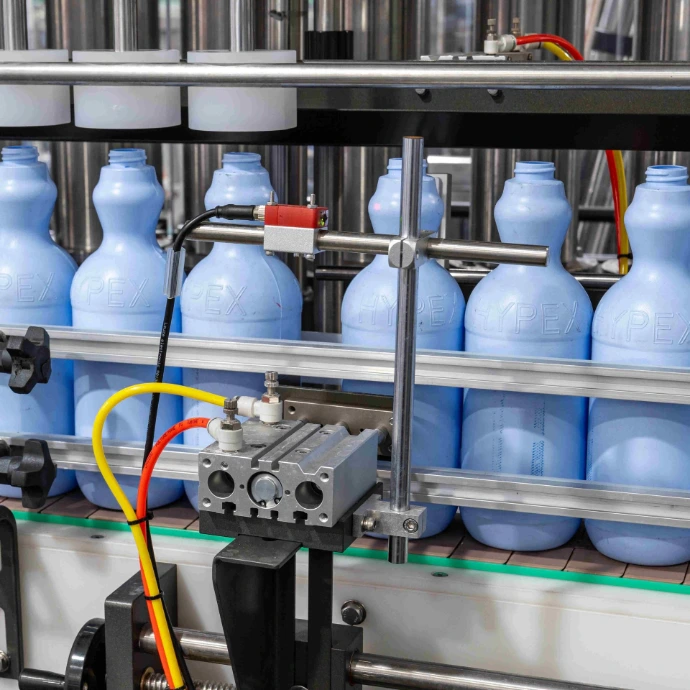
The practical specification questions follow from that. Which defects are detected, at which station, and what happens to a rejected container? A reject arm needs a collection point, a counter and a signal to the PLC, so a rejected bottle does not leave a gap in the pack pattern that the case packer then tries to fill. Vision checks need a defined acceptance threshold and a way to record the count by SKU, so a later quality dispute has numbers behind it. The quality control and CE certs page sets out the inspection records Runtech keeps on the machine side; the same discipline should apply to the line-side inspection modules in the contract.
Inspection also has a layout cost. Sensors, reject stations and their access space take conveyor length. On the turnkey project process page, the 3D layout stage is described as checking "conveyor transfers, operator reach, maintenance clearance and the distance between the filler and the capper on a real floor plan." A line drawing that fits six machines but leaves no room to reach a reject bin will be rebuilt on site, at the buyer's expense.
5. One control system, one set of handshakes
The category page calls the integrated setup a system with "centralized PLC controls, line-wide sensor synchronization, and customizable line layouts." That is the technical reason to buy a line from one integrator rather than six machine vendors. Each handoff needs an agreed signal: upstream ready, downstream busy, container present, group complete, fault and reset. If those are not defined, stations either wait on each other or collide, and the resulting stop looks like a mechanical fault but is a controls fault.
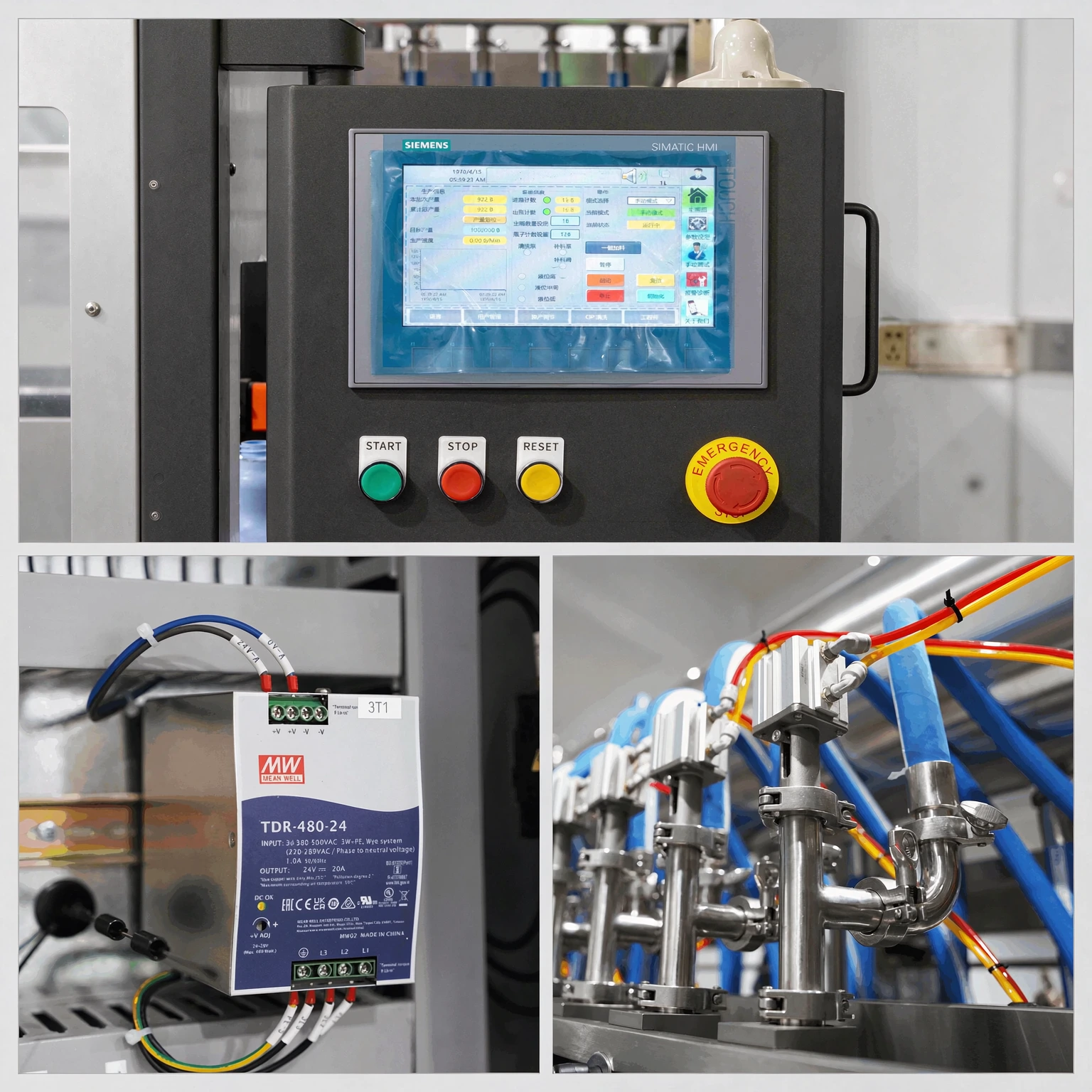
The complete bottle filling line specification guide makes the same point for the primary stations: the interfaces matter more than the peak speed of any single machine. Extend that to the back end and the specification should name the PLC and HMI, the recipe structure for format changeover, the emergency stop circuit across all stations, and who owns the program source. A format change on a line with several case sizes is a controls task as much as a mechanical one; filling and capping for multiple bottle sizes covers the same issue at the front of the line.
Ask for the handoff list in writing before the order: every signal between every pair of stations, with the fault behaviour for each. It is a short document, and it separates a supplier integrating the whole line from one shipping compatible machines. The turnkey project process page puts the commercial version plainly: "between machines nobody owns the seam."
6. Match the back end to the product and the industry
The Runtech category page names four settings for these lines: large-scale beverage, daily chemical, sauce, and pharmaceutical facilities. They do not need the same back end. The site's application pages give the product-side detail that should feed the line specification.
| Product family | What the back end has to handle | Application reference |
|---|---|---|
| Disinfectant and bleach | Corrosive product, compatible contact parts, secure closures | Disinfectant and bleach packaging |
| Detergent and dishwashing | Foaming liquids, large bottle formats, high case counts | Detergent and dishwashing bottling |
| Surface cleaner and trigger sprays | Trigger orientation, leakage risk in the case | Surface cleaner spray capping |
| Syrup and edible oil | Fill temperature, oxidation and crystallization control | Syrup and edible oil packaging |
| Viscous sauces and pastes | High viscosity, anti-drip nozzles, weight accuracy | Viscous sauce and paste filling |
| Body lotion and cream | Air pockets, small cosmetic containers, retail cartons | Body lotion and cream packaging |
| Shampoo and conditioner | Foaming, pump and flip-top closures, mixed SKUs | Shampoo and hair conditioner lines |
A sauce line that needs gentle handling and a beverage line that needs high case throughput will end up with different packers, different buffer lengths and different pallet patterns even if the filler is the same model. That is why a line proposal should start from the product list and the case list, not from a machine catalogue. The catalogues and technical manuals page is the place to request the current documents for each station before comparing quotations.
7. How a turnkey integration is delivered
On the turnkey project process page, Runtech sets out eight stages, each with a named deliverable and a required action from the buyer. The sequence doubles as a check on any integrator's proposal.
| Stage | What you receive | Your action |
|---|---|---|
| 1. Requirements and samples | Confirmed requirements checklist and a named technical contact | Send bottle and cap drawings or samples, product, target output, voltage and floor area |
| 2. 3D layout and quotation | 3D line layout and a detailed quotation within 24 hours | Confirm scope, model mix and floor plan |
| 3. Sample trial | Video trial report on your own product and a compatibility analysis | Approve the configuration before fabrication starts |
| 4. Manufacturing | Build records, material confirmation and access to a factory audit | Optional: audit the two Changzhou bases |
| 5. FAT | FAT protocol, trial report and video, contact-material confirmation, final inspection record | Agree the acceptance criteria in advance |
| 6. Export packaging and shipment | Packing list and shipping documents, wear-parts stock recommendation | Nominate the consignee and confirm destination documents |
| 7. Installation and training | A running line, a trained operator team and the machine documents | Prepare site, utilities, access and people |
| 8. After-sales | Remote fault diagnosis, source-direct spare parts, 18-month warranty cover | Report the fault with a description or grant remote access |
Two stages in that sequence carry more weight for a six-station line. Stage 2 delivers a 3D layout of the whole line, so conveyor transfers, operator reach and maintenance clearance are checked before anything is built. Stage 3 gates stage 4: fabrication starts only after the buyer approves a configuration that has already run the buyer's own product. A line with six stations has more handoffs to get wrong than a single machine, so the value of a trial is proportionally higher.
The factory overview and tour and CNC and manufacturing tech pages describe where the machines are built, and the warranty and after-sales policy and spare parts and tooling support pages cover what happens after commissioning. For a line rather than a single machine, ask how wear parts and format change parts are listed across all stations, since one missing change part can idle the whole line.
8. A specification checklist before you sign
- Sustained line output at the pallet, in cases per minute, and the slowest station that sets it.
- Full case and carton list: dimensions, pack pattern, closure method, print and barcode requirements.
- Station list with a rated cycle for each, plus buffer capacity between stations.
- Inspection points, defect list, reject handling, and how rejects are counted by SKU.
- Controls: PLC and HMI, the handoff signal list, emergency stop circuit, and format changeover recipes.
- Layout: 3D drawing, conveyor transfer points, operator reach, maintenance clearance and utilities.
- FAT criteria for the complete line, not just for individual machines, including the product and the run duration.
- Format changeover time measured on the buyer's own containers, recorded during the trial.
- Spare parts and wear parts list across all six stations, and the warranty terms for integration work.
- Named owner for every seam between stations, in writing, with an escalation contact.
The FAQ and troubleshooting and maintenance pages cover the questions that come up after handover. Before the order, the due-diligence checklist for filling machine manufacturers applies equally to a line integrator: ask who holds the drawings, the PLC program and the spare parts route.
Frequently asked questions
What is the difference between primary and secondary packaging?
Primary packaging is the container that touches the product: the bottle, the cap and the label. Secondary packaging groups finished containers for distribution, from conveying and inspection through case erecting, case packing, cartoning, shrink wrapping and palletizing.
What equipment is in a secondary packaging line?
A full line typically includes conveying and inspection equipment, a case erector, a case packer, a cartoner or shrink wrapper, and a palletizer. Lower-output lines may omit stations or run manual palletizing. Runtech groups these under secondary packaging and line integration.
How do I size a case packer for my filling line?
Start from sustained filler output and the pack pattern, then convert to case packer cycles per minute. Add buffer conveyor so a downstream cycle or a short upstream stop does not force the filler to idle. Specify the slowest station's output as the line output.
Can secondary packaging be added to an existing filling line later?
Yes, but it is a controls and layout project as much as a machine purchase. The existing conveyor outfeed, PLC signals and floor space have to be surveyed first. A 3D layout is the practical way to check transfers and access before ordering.
Who is responsible when a multi-vendor line has a bottleneck?
Without a single integrator, the handoff between machines often has no owner. The turnkey approach assigns one supplier to the whole line, including the seam signals and acceptance test. Runtech's process page describes this as the reason for its eight-stage delivery sequence.
What does a turnkey line integration include?
Requirements and samples, 3D layout and quotation, a sample trial, manufacturing, a 24-hour FAT, export packaging, installation and training, and after-sales support with 18-month warranty cover. Each stage has a named deliverable.