
Most filling machine enquiries start with a bottle and a target output, then get longer once the product is mentioned. Shampoo holds air, body lotion refills a cylinder slowly, bleach attacks wetted parts, and a 30 ml serum pack shows a dosing error that a 500 ml bottle hides. No single machine handles all of those cases. The buying decision runs from the product outward: first the metering principle, then the line layout, then the numbers that go into an enquiry.
Runtech builds filling machines for daily chemical, personal care, cosmetics, chemical and food plants. The range splits into linear, rotary and filling-capping monoblock lines, with metering by servo piston, gear pump, flow meter, weighing or tracking nozzles. The sections below cover how those choices fit together and which figures to confirm before you place an order.
Linear, rotary or monoblock: settle the layout first
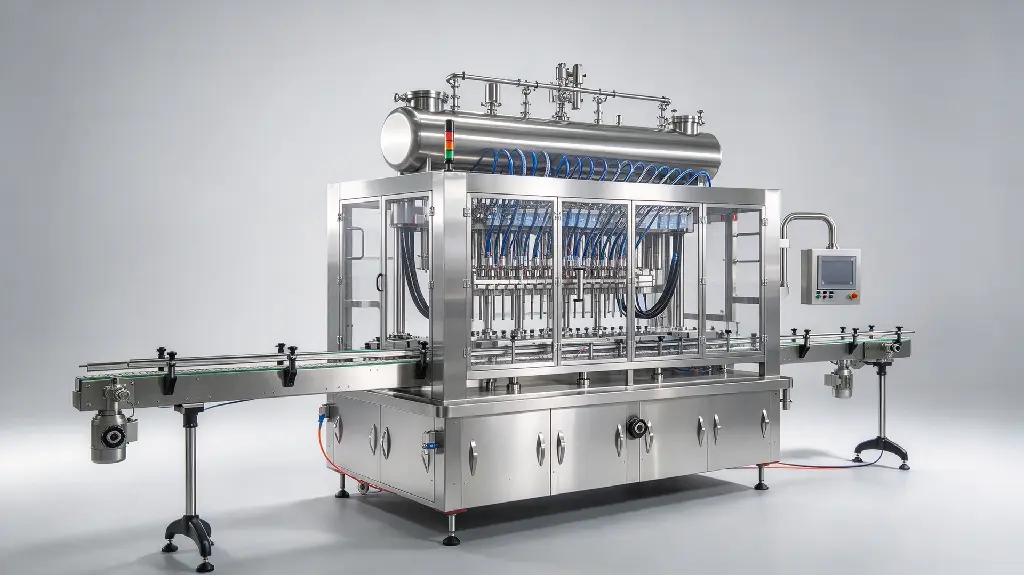
Layout decides footprint, changeover time and how easily the filler connects to a capper. The three configurations in Runtech's catalog correspond to three different production patterns.
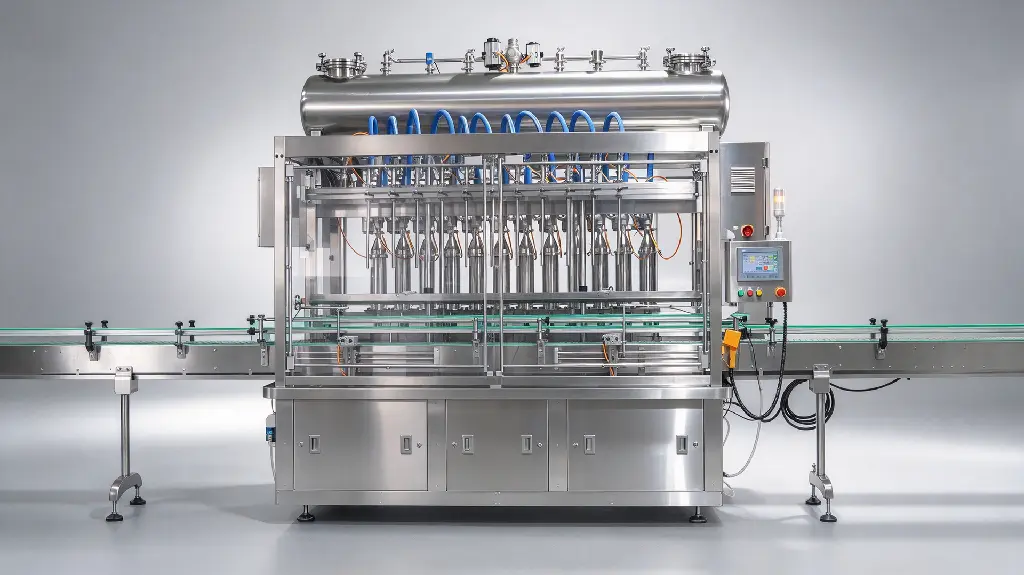
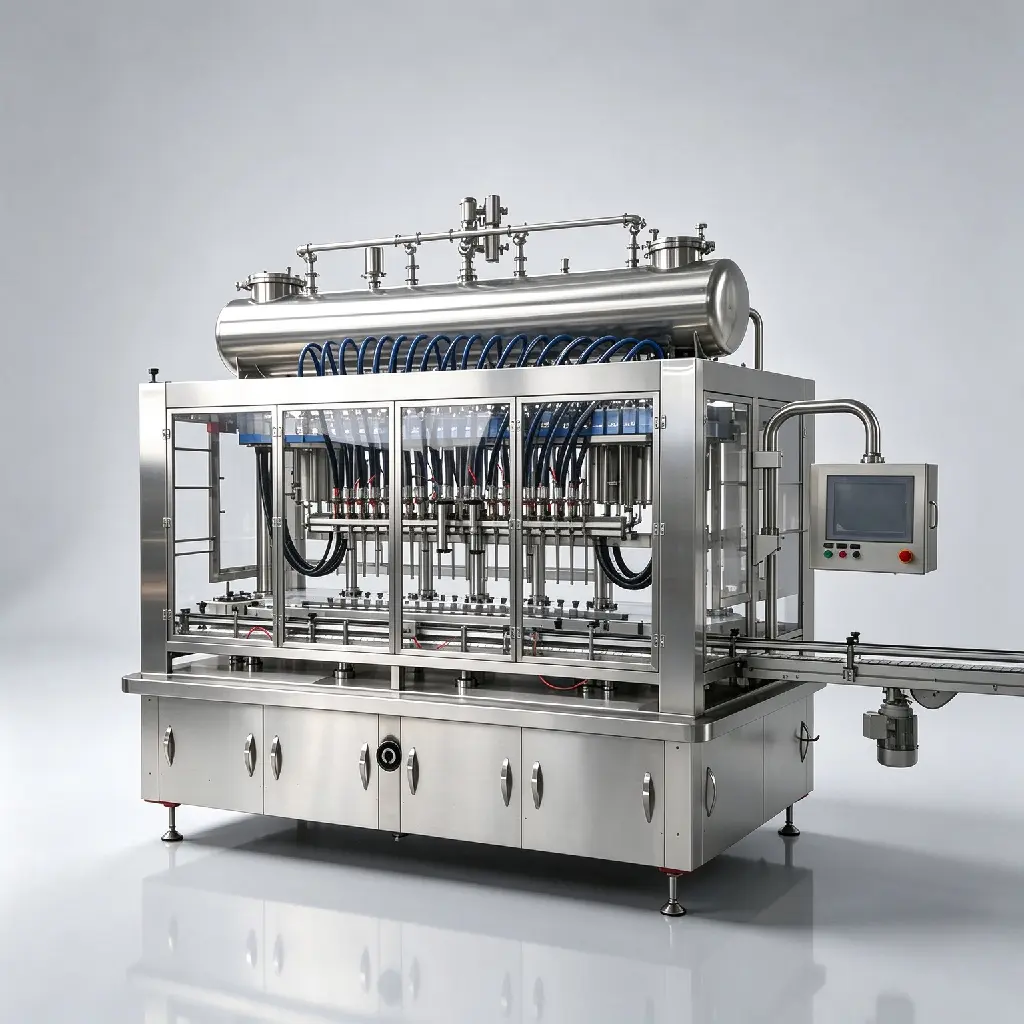
A linear filler indexes bottles along a straight conveyor and fills them while they are stopped. It suits medium output lines with mixed SKUs: quick changeover, a compact frame and adjustments that carry across bottle sizes and products. Runtech groups its linear filling machines by metering type rather than by bottle size, which tells you where the variation actually sits. Semi-automatic versions, where an operator places the bottle and the machine controls the dose, sit at the low-volume end of the same family.
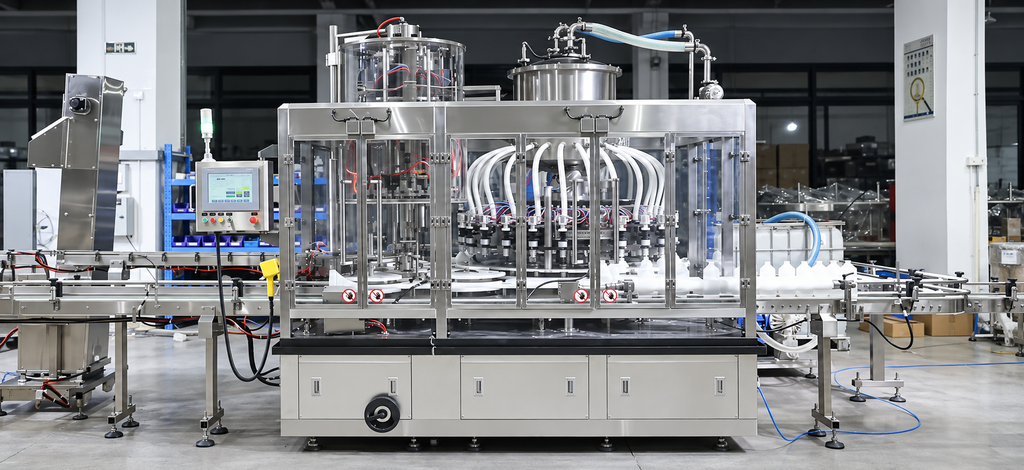
A rotary filler feeds bottles in sync with a rotating carousel and fills them at multiple stations during continuous motion. It earns its floor space when one or two bottles run for weeks at high output. Runtech splits rotary filling machines into rotary liquid and rotary paste or viscous liquid lines. The 30-nozzle servo rotary filler is the high-output end of that range; the servo piston rotary body lotion machine is built around flat and square bottles at around 6,000 BPH.
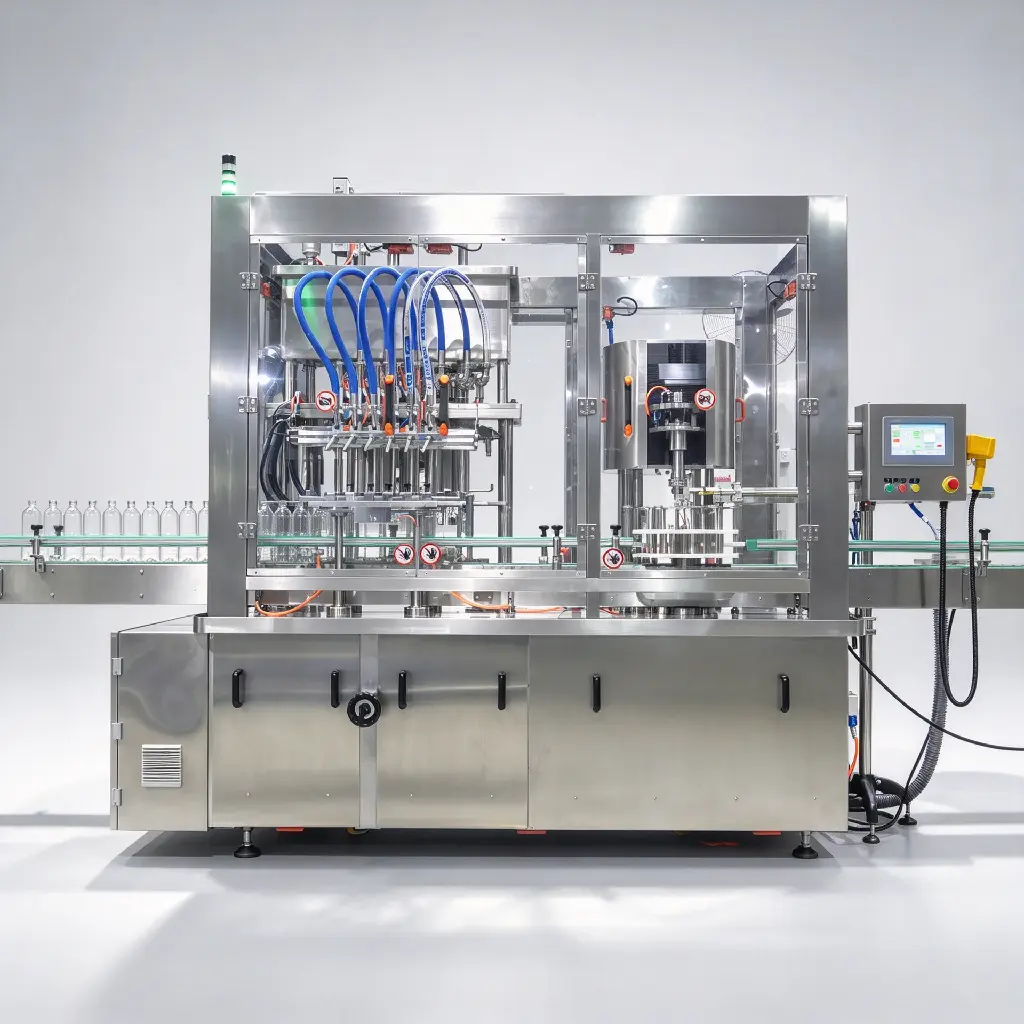
A monoblock combines filling and capping on one base, so there is no separate bottle transfer or alignment to tune between the two stations. It suits small cosmetic bottles, daily chemical lines and plants where floor space is tight. Runtech lists integrated filling and capping monoblocks for daily chemical and small cosmetic bottle work; the servo-controlled monoblock filler and capper is one example, with quick changeover across containers. A fourth, less tidy group covers customizable machines: shaped bottles, unusual closures or products that need tailored nozzles, fixtures and feeding.
That gives a workable rule. Many SKUs with weekly changeovers point to a linear machine. Long runs of a single bottle point to rotary. Small bottles where the fill and the cap have to stay together point to a monoblock.
Five metering principles, and what each one measures
The metering principle is the part of the specification that most often gets treated as a single line item. It determines what the machine actually controls, and therefore which products it can hold within tolerance.
| Metering principle | What it controls | Product fit | Limit to check |
|---|---|---|---|
| Servo piston | Displacement of one cylinder stroke, set by servo | Creams, lotions, pastes, products with particles | Refill time on thick products; seal and cylinder wear |
| Gear pump | Volume moved per gear revolution | Viscous liquids, oils, detergents | Shear-sensitive formulas; wear changes delivered volume |
| Flow meter | Volume passing an inline meter | Water-like liquids, chemicals, larger fills | Needs stable flow; density changes affect delivered mass |
| Servo weighing | Mass read from a load cell with feedback | Weight-critical fills, high-value products, 1-3 kg packs | Slower cycle; scale drift and plant vibration |
| Following or tracking nozzle | Nozzles travel with the moving bottle during the fill | Continuous lines, corrosive or splashing liquids | More servo axes; bottle pitch must stay consistent |
Runtech's linear category lists all five as separate subcategories, including servo piston filling machines. That split matters because the same frame can be quoted with different metering, and a quote that names only the number of filling heads says little about how the dose is held.
One published specification shows how much the accuracy figure depends on test conditions. Runtech states filling accuracy of -3 to +4 g below 1 kg and -4 to +6 g between 1 and 3 kg, under stated conditions of uniform specific gravity, product standing for more than four hours and no bubbles. Those conditions are part of the number, not fine print. A formula that arrives aerated straight from mixing will not reproduce them.
Match the metering to the product, not the catalog
Product behaviour narrows the choice faster than any comparison table. Four cases come up repeatedly.
Foaming liquids need the fill kept calm. Free-fall gravity filling and high-speed volumetric filling both whip air into surfactant-rich products, and slowing the line down trades throughput for appearance. Bottom-up or overflow-style filling keeps the liquid path below the surface; the foamy product guide covers the mechanism and the numbers behind it.
Thick or particulate products need a positive displacement method. A single viscosity value on a datasheet is a weak basis for this decision, since many creams and gels change how they flow with temperature and shear. The viscous product guide works through piston versus gear pump behaviour on real production conditions.
Corrosive liquids change the materials question. Bleach, acids and aggressive cleaners need anti-corrosion wetted parts and a liquid path that limits splashing and fumes. Runtech's tracking chemical bottle filler uses dynamic tracking nozzles and an anti-corrosion structure for that class of product.
Weight-critical or high-value fills push toward weighing with feedback, particularly on 1-3 kg packs where a small volumetric error becomes expensive giveaway. Net content rules point the same way.
Test with the real product at production temperature, after the standing time the plant will actually use. A short demonstration on a neutral liquid proves that a machine can be set up; it does not prove it will hold the setting on the third hour of a shampoo run.
Output and head count: read the 6,000 BPH figure properly
Capacity figures are quoted for a stated product, volume and container. Runtech publishes around 6,000 bottles per hour at 330 ml on glass cleaner, with a four-head configuration on the industrial automatic bottle filling machine and eight heads with a 500 ml cylinder on a related specification. Move to 1 L, a foaming formula or a shaped bottle and the same machine lands somewhere else.
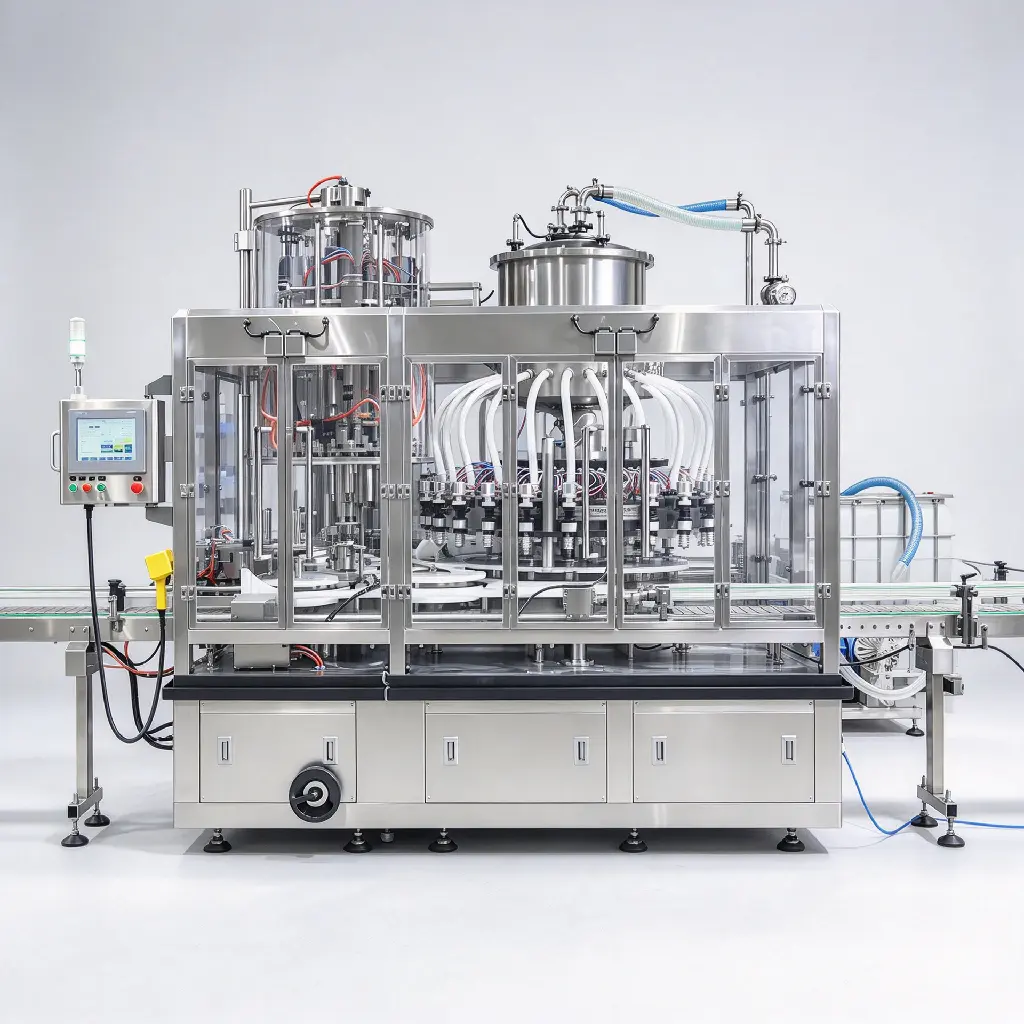
Head count follows from sustained output, not from the peak figure in a brochure. Divide the target bottles per hour by the realistic cycles one head can complete, then allow for planned stops and changeovers. The industry application guide uses an 80 percent OEE planning figure for exactly this reason: eight theoretical heads at high speed do not deliver eight heads worth of saleable bottles over a shift.
Check the rest of the line at the same time. A filler that outruns the capper or labeler simply builds a queue. Rotary layouts such as the 30-nozzle servo machine make sense only when bottle supply, capping and downstream conveying are sized to match.
The spec sheet to send suppliers
A useful enquiry reads like a test plan. Vague ranges such as "100 ml to 1 L bottles" leave the supplier to guess at geometry, which is where most later disputes start.
| Spec | What to state | Why it matters |
|---|---|---|
| Bottle range | Diameter, width, depth and height for every SKU, including extremes | Tooling, guides and nozzle stroke |
| Fill volumes | Minimum, maximum and target per SKU | Cylinder or meter sizing |
| Product behaviour | Viscosity at production temperature, foam tendency, particles, corrosiveness | Metering principle and wetted materials |
| Target output | Sustained bottles per hour, plus shift length | Head count and layout |
| Accuracy | Acceptable deviation and the conditions it must hold under | Which metering principle is viable |
| Changeover | SKUs per week and allowed switch time | Recipe memory and quick-change parts |
| Utilities | Power, compressed air, water or CIP supply | Installation and running cost |
| Compliance | Net content rules, cleaning and batch records | Weighing feedback and documentation |
Runtech's published specification for the automatic bottle filling machine gives a concrete template: application range 1500-2000 ml for water-like and viscous non-corrosive liquids, container diameter 60-150 mm and height 250-350 mm with special bottles customizable, 3 kW three-phase 380 VAC 50 Hz, clean stable compressed air at 0.5 MPa or above and no more than 0.3 m3/min, SUS304 main construction with SUS316L product-contact parts, RS-485, Ethernet and USB interfaces, noise below 78 dB, a footprint of 1,930 x 1,453 x 3,000 mm and roughly 1,920 kg. State your own numbers in the same terms. For lines running several formats, the multi-size buying guide sets out the size matrix worth sending with the enquiry.
Acceptance tests before you sign off
Agree the test before the machine is built, and run it on the hardest SKU rather than the easiest one. Include the smallest dose, the least stable bottle, the most viscous or foaming formula and the boundary of the diameter range.
Watch more than the average fill. Record net content deviation across a continuous run, fill level consistency from bottle to bottle, drips on the neck and thread, foam at the surface and capping torque on monoblock systems. On the servo monoblock, published torque runs 0.2-20 N.m, so check the setting against each closure instead of accepting one value for the whole range.
Then time a changeover with the actual parts and recipe, and repeat the accuracy check after cleaning. A good single fill proves the machine can be set up. Two hours at production speed proves it can hold the setting. Ask the supplier to confirm the size matrix format by format, including which adjustments are operator settings and which need dedicated parts.
Where each configuration runs
Daily chemical and home care lines fill laundry detergent, dish soap, surface cleaners and disinfectants into HDPE bottles. Anti-drip nozzles and stable bottle positioning matter more here than peak speed, because residue on the neck turns into capping rejects downstream. The automatic filling machine range is specified for that work.
Cosmetics and personal care run smaller packs and more SKUs, often with glass or decorated bottles that show every drip. Monoblocks and small-bottle fillers dominate. Chemical, agrochemical and lubricant lines add corrosion resistance and heavier containers, from gear oil to grease cartridges. Food and beverage work brings juice, edible oil, honey and sauces, where a rotary filling and capping monoblock can keep the glass bottle under control through both stations.
Once the filler is settled, the rest of the line follows. The bottle labeling machine buying guide covers the downstream choice in the same format as this one.
FAQ
What is the difference between a liquid filling machine and a bottle filling machine?
There is no functional difference. Both describe equipment that doses product into a container. The useful distinction is the metering principle and the line layout, not the name on the quote.
Which filling principle should I use for a foaming product?
Keep the liquid below the surface with bottom-up or overflow-style filling and a controlled nozzle path. Free-fall gravity filling and high-speed volumetric filling both pull air into surfactant-rich formulas. Slowing the line helps appearance but reduces output, so it is a fallback rather than a specification.
Can one machine run both creams and thin liquids?
Often yes, if the metering covers both ranges and the changeover is planned. A servo piston handles a wide viscosity span, but the stroke, refill time and nozzle set differ by product. Do not expect one saved recipe to hold both.
How many filling heads do I need?
Work from sustained bottles per hour, divide by realistic cycles per head and allow for planned stops and changeovers. Round up, then check that the capper, labeler and conveyor can match the resulting rate.
What accuracy should I expect?
Runtech publishes -3 to +4 g below 1 kg and -4 to +6 g for 1-3 kg, conditional on uniform specific gravity, the product standing more than four hours and no bubbles. Treat those conditions as part of the specification and verify with your own product at production temperature.
Is a linear or rotary filler cheaper to run?
It depends on the SKU count and annual volume, not on purchase price alone. A linear machine usually costs less in changeover time and floor space on mixed lines. A rotary machine spreads its cost over long, high-output runs of a single bottle.