
Foamy product filling is one of the most common complaints we hear from users of liquid filling machines in home care, personal care, and low-viscosity beverage plants. Shampoo, dish soap, hand sanitizer, glass cleaner, and craft spirits all share the same trait: they hold air easily, and that air turns into foam the moment the liquid drops into a bottle.
Here is the good news. The fix is usually not "slow everything down" or "dump in more defoamer." For many low- to mid-viscosity products, the right answer is a change in filling method, and that is where the overflow filling machine earns its keep. Below, we break down why foam forms, why standard fillers lose to it, and what the numbers look like after a switch to overflow filling.
Key Takeaways
- Foam in filling comes from air entrapment plus surfactants, and it causes three costly problems: inaccurate fills, dirty bottle necks, and capping rejects.
- Free-fall gravity filling and high-speed volumetric filling both create turbulence that whips air into foamy products; slowing down protects quality but sacrifices throughput.
- An overflow filling machine locks the fill level at the bottle neck using a double-tube nozzle and product recirculation, achieving fill-level consistency of about ±0.5 to ±2 mm while returning excess product to the supply tank.
- Overflow filling suits low- to mid-viscosity, appearance-sensitive products like shampoo, sanitizer, and spirits; it is not the right choice for thick pastes or weight-critical fills.
- Fix the liquid path upstream (tank vortexes, pump leaks, splashing return lines) before blaming the filler, and treat defoamer as a last resort, not a first move.
What Happens When You Fill Foamy Products?
Foam is trapped air stabilized by surfactants, and it behaves like a liquid that lies about its volume. Foamy product filling fails in a specific way: trapped air inflates the measured volume, so bottles look full but weigh short, necks get contaminated, and capping rejects climb. When a bottle is half product and half foam, the fill fails on the scale, on the shelf, and sometimes with regulators.
Why Surfactant-Rich Products Foam So Easily
Shampoo, body wash, dish soap, and hand sanitizer are built around surfactants. These molecules reduce surface tension, which is exactly what makes them good cleaners. The same property lets air bubbles survive instead of popping. Add any mechanical disturbance, a fast pour, a sharp nozzle, a splash against the bottle bottom, and the product whips itself into foam the way a whisk whips egg whites.
Temperature plays a role too. Warmer product has lower viscosity, so it entrains air more easily during turbulent flow, while cold, thicker product holds bubbles longer. Either way, the product arrives at the nozzle ready to foam, and the filling method decides how much foam you get.
The Three Ways Foam Wrecks Your Fill
Foam is not just a cosmetic nuisance. It attacks your line in three places at once.
- Inaccurate net content. Foam occupies volume without adding weight. Bottles look full at the neck but weigh short, which is a net content compliance risk, not just a quality issue.
- Overflow and contaminated necks. Rising foam creeps past the neck, leaving residue on the bottle exterior and threads. Cappers slip, torque readings go wrong, and rejects climb.
- Downtime and labor. Someone has to wipe bottles, mop spill trays, and re-run short fills. Every one of those minutes is capacity you paid for but never received.
Symptom-to-Root-Cause Quick Check
Before you touch any settings, use this table to trace what you are seeing on the line back to its likely cause.
Symptom on the Line | Likely Root Cause | Quick Check |
Bottles look full but weigh short | Foam filling the headspace; volumetric filler counting foam as product | Weigh a sample of "full" bottles against declared net content |
Foam overflowing the bottle neck | Fill nozzle too high above the liquid; free-fall drop creating bubbles | Measure nozzle-to-liquid distance; is it over 20 mm? |
Foam residue on threads, capping rejects rising | Fill level set too high for the bottle, or foam climbing during fill | Check where foam sits relative to the neck finish |
Fill levels inconsistent between bottles | Bottle interior volume tolerance, or turbulent entry splashing the walls | Measure empty bottle volumes across a batch |
Foam building up in the product tank | Tank vortex, leaking suction fittings, or return line splashing above the liquid | Inspect suction joints and watch the tank during recirculation |
Machine slows down to avoid mess | Nozzle speed and profile mismatched to the product | Review whether operators have already dialed speed far below spec |
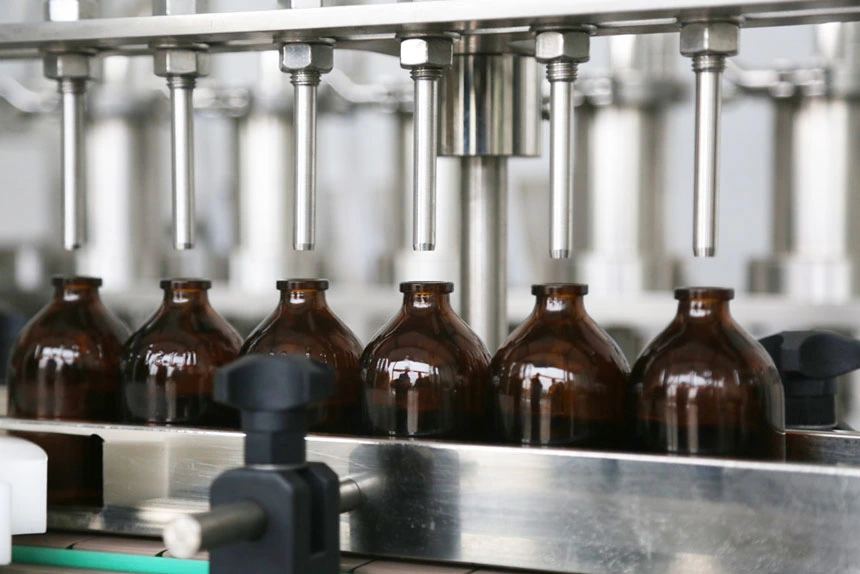
Why Do Standard Filling Machines Struggle with Foamy Liquids?
Most foamy product filling problems trace back to one thing: the machine treats foam-prone liquid the same as still liquid. That assumption breaks down in three specific, predictable ways.
The Free-Fall Problem
A gravity or time-pressure filler on an overhead system drops liquid from the nozzle into the bottle. From a height of even 30 to 50 mm, liquid hits the bottle bottom fast enough to fold air into surfactant-rich product. The foam then rises to meet the incoming stream, which stirs it further. Mechanical agitation and air entrainment are the trigger, not the product alone, as IDA's guidance on foaming liquids notes.
Turbulence, Back Pressure, and the "Foam-Filled Neck" Illusion
Volumetric and piston fillers measure what leaves the nozzle, not what ends up as liquid in the bottle. In a foam-prone fill, the measured dose can be correct while the bottle contains less actual product than declared, because bubbles occupy the difference. The neck looks full, the label says 500 mL, and the scale disagrees. Inspectors weigh bottles, not eyeball them. Under U.S. net content rules (NIST Handbook 133), a bottle that looks full but weighs short is a violation, not a gray area.
Why Simply Slowing Down Is a Trade-Off, Not a Fix
The standard first response is to slow the fill and lower the nozzle closer to the liquid. Keeping the nozzle tip within roughly 10 to 20 mm of the liquid surface, and using a slow-fast-slow profile, does reduce foaming meaningfully. But a slower cycle means fewer bottles per hour, and on a two-shift line the throughput loss compounds fast. Slowing down manages foam. It does not get rid of it.
How Does an Overflow Filling Machine Handle Foamy Products?
This is where the conversation shifts from "how do we tame the foam" to "how do we design the foam out." Overflow filling, sometimes called constant level filling, does exactly that.
The Double-Tube Nozzle, Explained
An overflow filling machine uses a double-tube nozzle. Product pumps down the inner tube into the bottle. When the liquid rises to the overflow port set at the target level, everything above it flows up the outer tube and returns to the supply tank.
The result is a fill level physically locked to the port position, giving ±0.5 to ±2 mm consistency across the run. Every bottle fills until it reaches the same point, so small differences in bottle interior volume simply stop mattering. That is why overflow fillers are also called constant level fillers, and why the technique shows up wherever shelf appearance matters. For a step-by-step breakdown of the mechanism, see our guide on how overflow filling machines work.
[IMAGE: Cutaway diagram of an overflow filling nozzle showing the inner feed tube, outer return tube, overflow port at the set fill level, and the recirculation line back to the supply tank]
Why Recirculation Naturally Removes Foam
The recirculation loop itself is what makes overflow filling a native solution for foamy products rather than a workaround. The product that overflows back to the tank carries entrained air with it, and the return line discharges below the liquid surface, so the foam has time to dissipate before the product recirculates. In practice, the overflowed product comes back instead of going to waste, and the foam leaves the bottle instead of living in it.
Compare that to a volumetric system, where excess foam either stays in the bottle or goes down a drain. Overflow filling turns the reject stream into a return stream.
Which Products Are a Good Fit
Overflow filling shines on low- to mid-viscosity, appearance-sensitive products, which is precisely the list where foam causes the most trouble:
- Shampoo, body wash, and hand soap
- Hand sanitizer and rubbing alcohol solutions
- Dish soap, household detergents, and glass cleaner
- Wine, spirits, and other low-viscosity beverages in clear bottles
If you sell any of these in a clear bottle, shelf consistency is part of your brand. A shampoo filling machine built on overflow principles protects that consistency at line speed.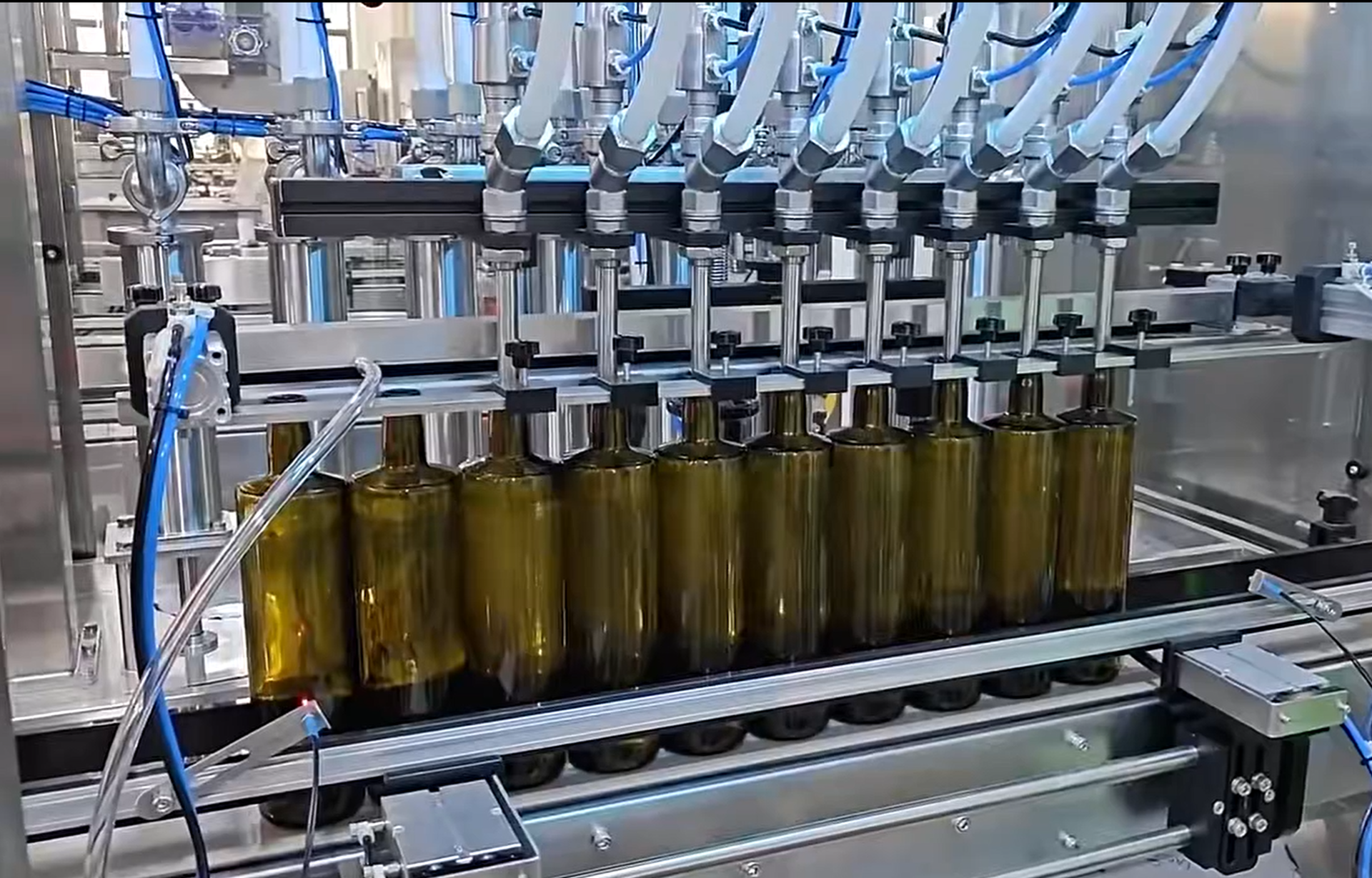
Choosing Between Overflow, Dive Nozzle, and Volumetric Filling
Not every line should be an overflow line. This table sums up where each method wins.
Criterion | Overflow (Constant Level) | Dive / Bottom-Up Nozzle | Volumetric / Piston |
Foam control during fill | Excellent; excess and foam return to tank | Good; low agitation if nozzle stays near liquid | Poor without dive nozzle and slow profiles |
Fill-level consistency | ±0.5 to ±2 mm, excellent for clear bottles | Moderate; follows bottle volume tolerance | Not its goal; controls volume, not level |
Net content accuracy | Indirect; depends on bottle tolerance | Good | Excellent, best for weight-declared products |
Throughput at low foaming | High; fills fast since level is self-limiting | Reduced by slow-fill profiles | High for viscous products |
Suitable viscosity | Low to mid (water-like to light emulsions) | Low to mid-high | Low to very high (pastes, gels) |
Typical best fit | Shampoo, sanitizer, spirits, cleaners | Mid-viscosity foamy products, taller bottles | Creams, gels, honey, weight-critical fills |
Where Overflow Filling Is NOT the Answer
We would rather lose a sale than sell the wrong machine. Overflow filling has honest limits:
- High-viscosity pastes and gels. Thick products do not flow up the return tube reliably. If you fill honey, toothpaste-grade gels, or heavy creams, a servo piston filler with dive nozzle is the better tool.
- Weight-critical, non-appearance-sensitive fills. If your product goes into an opaque bottle and your obligation is net content by weight, volumetric accuracy matters more than level consistency.
- Ultra-high-speed fills of very lightweight foamy liquids. When foam generation outpaces even recirculation, you may need vacuum filling or a formulation change on top of the equipment change.
If you want a straight answer on fit, send us your product specs and bottle drawings. A quick review of viscosity, foaming tendency, and bottle geometry tells you within days whether overflow filling is your method.
Case Study: Overflow Filling Machine Cuts Foam Rejects by 92%
The following composite case study is based on aggregated data from real customer projects, with details adjusted to protect confidentiality.
A North American hand sanitizer producer was running a semi-automatic gravity filler on 250 mL PET bottles. Foam from the free-fall fill left residue on roughly one in six bottles. Quality rejected or re-wiped them, the capper jammed on slippery necks, and two operators spent close to three hours per shift doing little else but wiping bottles by hand.
The diagnosis matched the pattern above: a 40 mm free-fall drop, no fill profile control, and a return line splashing into the tank and re-entraining air. The fix combined three changes: an overflow filling machine with a recirculation tank returning below the liquid surface, nozzles set close to the liquid level, and a slow-fast-slow profile on the first seconds of each fill.
Metric | Before | After |
Foam-related bottle rejects | ~17% of production | ~1.4% (a 92% reduction) |
Manual bottle-wiping labor | ~3 hours per shift | Eliminated |
Fill-level consistency across bottles | Highly variable | Within ±1.5 mm |
Effective throughput | ~22 bottles/min (throttled to control foam) | ~32 bottles/min |
Product loss to spill and reject pours | ~2.1% of batch volume | <0.2% (overflow returned to tank) |
The payback story mattered as much as the reject number. The recovered throughput alone paid for the machine in under a year at their volumes, before counting the labor hours returned to production.
Case Study: Craft Spirits Bottling with an Overflow Filler
Here is a shorter composite example, from a very different corner of the market. A craft distillery bottling 750 mL clear-glass bottles of low-viscosity spirit was frustrated by visible level differences between bottles on the shelf. Their dive-nozzle volumetric filler dosed accurately by volume, but bottle-to-bottle interior tolerance showed up as visible level variation, and every milliliter of overfill went straight down the drain.
Switching to an overflow filler delivered two wins at once. Fill levels on the shelf became visually identical, which matters enormously in spirits retail, where customers compare bottles side by side. And every drop of overfill returned to the tank, trimming giveaway on a premium product. For anyone bottling transparent liquid at a premium price, that combination of shelf consistency and near-zero loss is the overflow value proposition.
[IMAGE: Row of clear glass bottles filled to visually identical levels, demonstrating shelf-consistent fill lines]
See more examples like these in our Industry Solutions & Case Studies collection.
What Are the Most Common Mistakes When Fixing Foam Problems?
Before you spend money on hardware, make sure the cheap fixes are not being skipped first.
Mistake 1: Reaching for Defoamer First
Defoamer at 0.01% to 0.1% of batch weight can suppress foam, and in some formulations it is legitimate. But it is a formulation-level compromise. It can affect the product's feel, clarity, or rinsability, and for food, pharma, or personal care products it may require reformulation approval. Meanwhile, the machine keeps injecting air at the same rate.
Mistake 2: Ignoring the Liquid Path Upstream
A large share of foamy product filling problems originate before the nozzle. A pump suction joint drawing in air, a tank level low enough to create a vortex over the outlet, or a return line discharging above the liquid surface can each put more air into the product than the filler does. Seal the suction path, keep tank levels healthy, and route returns below the surface. Sometimes that alone halves the foam reaching the nozzle.
Mistake 3: Overlooking Bottle Tolerance
If fill levels vary bottle to bottle on a volumetric system, check the bottles before you blame the machine. Interior volume tolerance in cheap or recycled bottles can easily exceed a few milliliters, and no volumetric filler can make those bottles look the same on a shelf. This is precisely the variation overflow filling absorbs by design.
Foam Problem Checklist
Work through this list in order before changing any filling method:
- Run the quick check table above and confirm where the air is entering, from suction leaks to splashing returns.
- Measure nozzle-to-liquid distance; reduce it toward the 10 to 20 mm range.
- Add or tune a slow-fast-slow fill profile, especially in the first seconds.
- Check where foam sits relative to the bottle neck finish and your target level.
- Sample empty bottles for interior volume tolerance.
- Only then evaluate defoamer with formulation approval, and if foam rejects persist, compare filling methods against your product's viscosity and bottle material.
FAQ: Foamy Product Filling
Yes, with conditions. A piston filler paired with a dive nozzle that stays close to the rising liquid, plus a slowed fill profile, can handle moderately foamy products. That is especially true for mid- to high-viscosity products, where overflow return tubes struggle. For thin, highly foamy products in clear bottles, overflow filling usually delivers better results with less tuning.
Overflow filling controls fill level; volumetric filling controls dose volume. Overflow typically holds fill level within ±0.5 to ±2 mm, which is ideal for appearance but only as accurate as your bottle volume tolerance in net-content terms. Volumetric filling controls dose volume precisely but says nothing about the visible level. Choose overflow when you sell appearance, volumetric when you sell weight.
In most cases, no. The recirculation loop carries foam out of the bottle and back to the tank, where it dissipates, and returning product below the liquid surface avoids re-entrainment. Some formulations still benefit from a small defoamer dose, but treat that as a formulation decision, not a filling-line requirement.
Overflow filling works best from water-like liquids up to light lotions and emulsions, roughly the range that pours readily and flows up a return tube without pressure. Thick gels, pastes, and heavy creams are a poor fit; for those, look at piston or servo pump fillers with dive nozzles.
The Bottom Line on Foamy Product Filling
Foam in filling is a mechanical problem with a mechanical solution. Start by finding where air enters your liquid path, from suction leaks to splashing returns. Keep nozzles close to the liquid and use staged fill profiles to cut agitation. And when the product is thin, foamy, and sold in a bottle where the fill line is part of the look, stop fighting foam with slower speeds and start designing it out with recirculation.
That Ontario sanitizer manufacturer from the opening email? Their fix was not a faster machine. It was a different method: the overflow return carried the foam away, the rejects collapsed, and the operators who used to wipe necks went back to running production.
If foam is costing you rejects, labor hours, or shelf consistency, send us your product specs and bottle drawings. We will review your product, viscosity, and bottle geometry and tell you honestly whether an overflow filling machine is the right answer, or whether another method fits your line better. No obligation, just a straight engineering answer.