
1.Why Industries Stress Cappers Differently
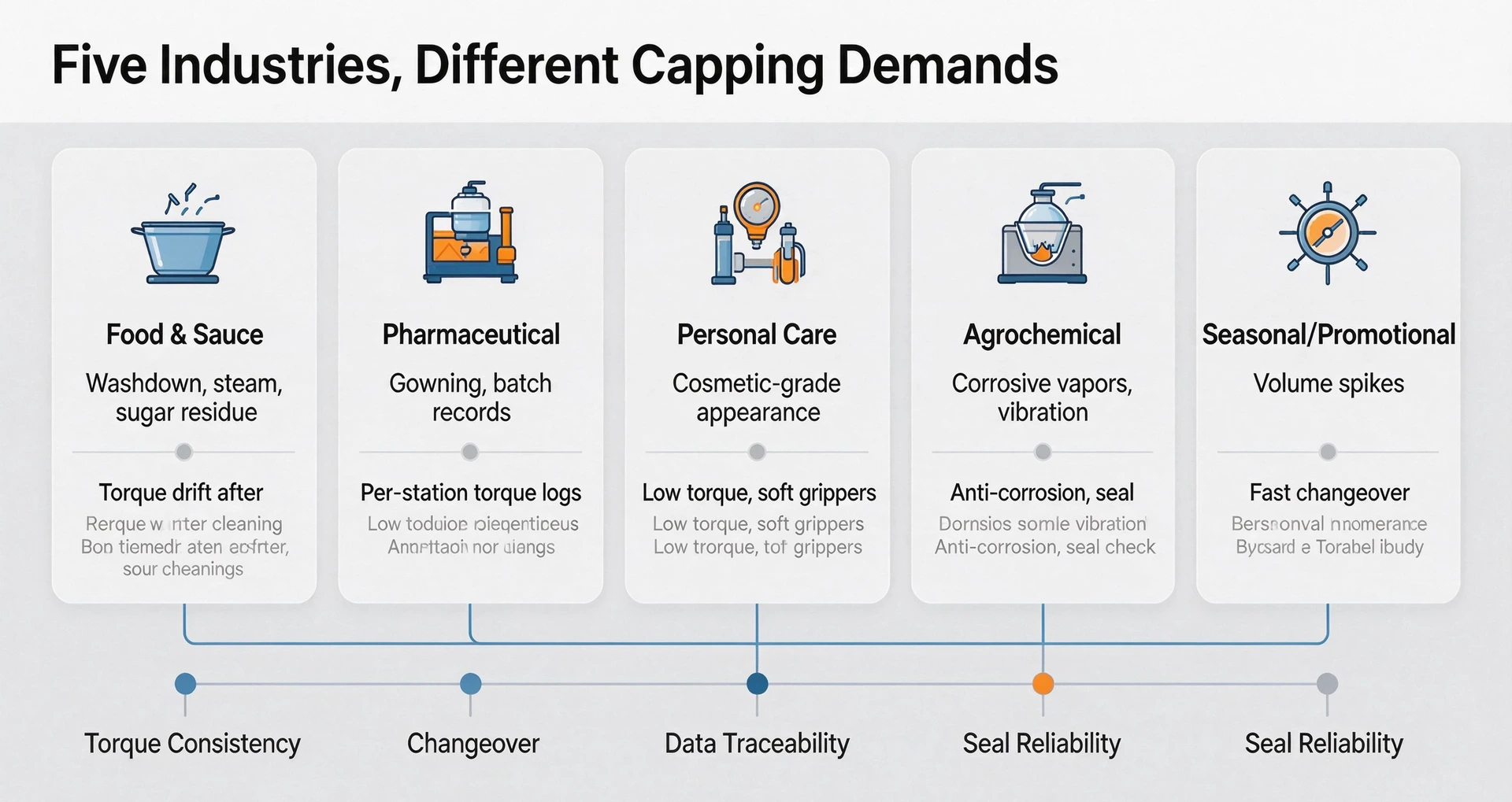
Before the cases, it helps to see the pattern. An industry does not just choose a cap; it chooses an entire production environment, and that environment acts on the machine daily.
Industry | Production Environment | What It Does to the Capper | Design Response |
Food & Sauce | Washdown, steam, sugar residue on surfaces | Corrodes exposed fasteners; fouls sensors; torque drifts after cleaning | Washdown-rated enclosures, sloped frames, sealed sensors |
Pharmaceutical | Gowning, cleaning validation, batch records | Every adjustment must be documented; crevices are audit findings | Crevice-free contact parts, torque logging, 316L |
Personal Care | Cosmetic-grade appearance standards | A scratched pump cap is a consumer complaint, not just a defect | Low torque range, soft grippers, gentle rails |
Agrochemical | Corrosive vapors, outdoor storage, transport vibration | Electronics corrode; seals loosened by stacking loads | Anti-corrosion build, sealed electronics, seal verification |
Seasonal / Promotional (sanitizer, gift sets) | Sudden volume spikes, short campaigns | Machines sized for average volume stall at peak | Speed headroom, fast changeover parts |
The rest of this article takes each major environment in turn, then shows what these forces did to three real lines.
2.Food & Sauce Lines: Where Washdown Meets Torque
A sauce plant is the most punishing ordinary environment a capper will ever see. Between shifts the line is hosed down; steam and sugar film settle into every horizontal surface; conveyor lubricant migrates onto bottle bodies. Each of these has a documented failure mode.
The torque drift after washdown is the sneaky one. Water temperature softens caps stored near the line, so the afternoon shift caps with a different effective torque than the morning shift — same machine, same setpoint, different result. Plants that log torque every 30 minutes see this immediately; plants that spot-check once per shift see it as a mystery reject.
Hygiene pressure also decides machine details before performance does. Open frames that can be rinsed without disassembly, fasteners that will not pit after a year of caustic spray, and cable routing that does not trap sauce residue — none of these appear in a speed comparison, yet they decide which machine the maintenance team actually respects.
3.Pharma & Nutraceutical: The Batch Record Follows the Machine
In pharma the machine is only half the deliverable. The other half is the evidence trail: which torque was applied, to which batch, by which station, and who verified it. A capper that cannot export per-station, per-bottle torque data creates audit findings even while sealing perfectly.
This is why servo-torque heads dominate pharma despite their cost. The torque is programmed rather than adjusted by clutch feel, it can be locked behind a permission level, and every value lands in a log a QA manager can print. Child-resistant caps add a second requirement — the capper must seat the outer cap without damaging the inner CRC liner — which pushes lines toward controlled dwell rather than raw speed.
Nutraceutical plants occupy an interesting middle ground: audit expectations are rising, but line speeds resemble food more than pharma. The practical result is pharma-style logging on food-style budgets, which makes data export capability the first question to ask a supplier in this segment.
4.Personal Care & Cosmetics: The Closure Is Part of the Product
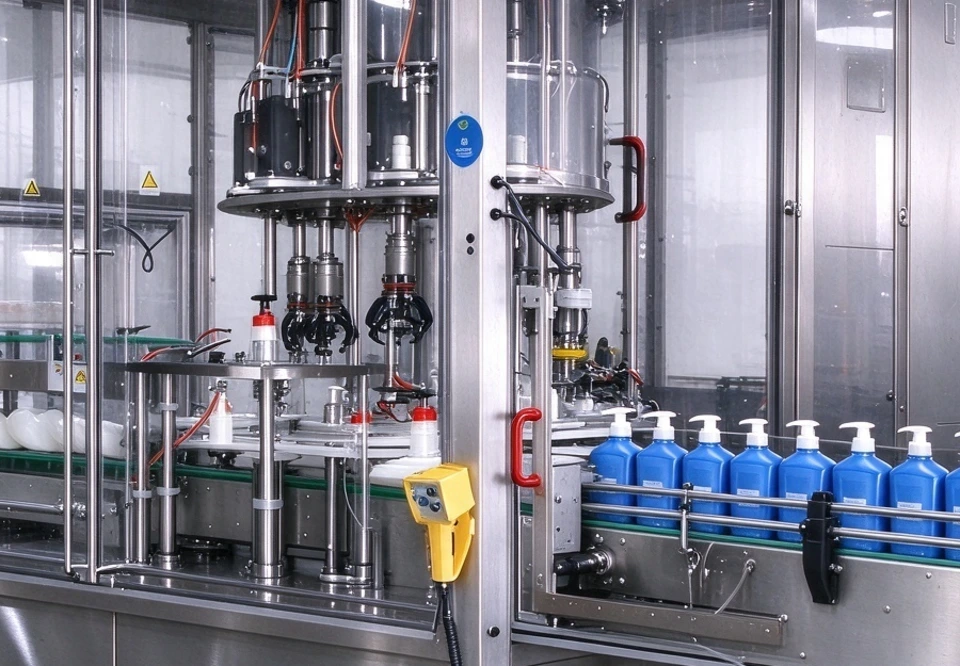
In cosmetics, the cap is not packaging; it is merchandising. A scratched pump collar or a distorted sprayer skirt is visible on the shelf and generates consumer complaints that cost more than the cap. This changes what "good capping" means: the torque must be low enough to leave no tool marks, yet high enough that the pump does not loosen in transit.
Airless pump bottles make it harder still. Their stiff pistons and precise pump stems need centered, gentle engagement, and their premium price means the line cannot afford aggressive gripping of any kind. Lines running these formats typically specify a narrow low-torque window, soft-jaw grippers and polished guide rails — details that sound minor until the first-pass yield on a beauty SKU is compared before and after.
The machines that succeed here are not the fastest ones. They are the ones whose vendors can demonstrate a low-torque window holding steady across a full shift.
5.Agrochemical & Household Chemicals: The Line Is Not Where Bottles Live
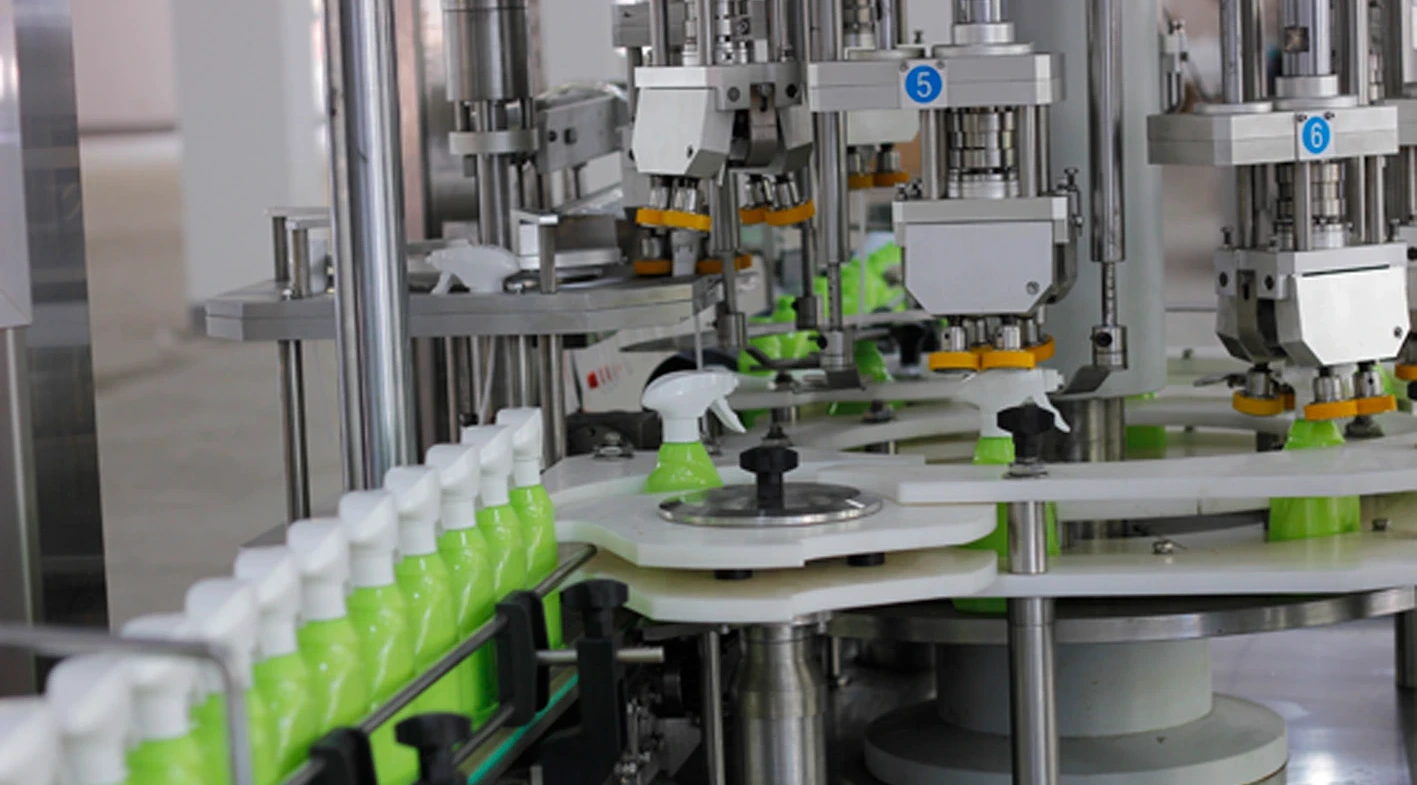
Agrochemical bottles leave the factory, sit in warehouses, ride trucks and get stacked in farm sheds — conditions the production floor never sees. A cap that passes the torque tester at the end of the line can still weep after two weeks of vibration and UV exposure in a distributor's yard.
That is why mature chemical lines combine three defenses rather than trusting one: correct capping torque, an induction or liner seal beneath the cap, and a downstream leak check on filled product. The capper's job in this environment starts with surviving it — corrosion-resistant builds, sealed electronics and chutes that tolerate chemical dust — and only then moves to speed.
Household chemicals sit between agrochemical and personal care: corrosive-ish products, retail appearance standards, and bottles that get squeezed by consumers. Their lines borrow anti-corrosion builds from one industry and gentle gripping from the other.
6.Three Customer Cases
The three projects below ran in three different industries and failed in three different places — none of them where the customer first looked.
Honey packer, glass jars. A regional honey brand capped by hand on a 45 bpm line with four operators doing nothing but closing jars. Breakage was running high because hand-capping torque varies by operator, and loose lids were leaking into shipping cartons. After moving to an automatic capper, one operator now covers the same station at 90 bpm, and jar breakage fell by roughly 60% — consistent torque turned out to be gentler on glass than human hands. The payback question had been framed as a labor calculation; the breakage reduction paid for the machine faster than the wages saved.
Contract packer, multi-brand filling. A co-packer running eight brands across one rotary capper was losing whole shifts to changeovers — 90 minutes per switch, with technicians re-learning each format from paper notes. The fix was organizational as much as mechanical: quick-change starwheels and grippers, plus a stored torque recipe per brand recalled from the HMI. Changeover dropped to about 25 minutes, and annual line utilization rose by 18% without touching the machine's top speed. For multi-format plants, the changeover system deserves as much scrutiny as the capping heads.
Cosmetics plant, airless pump bottles. A beauty manufacturer was seeing a 3.9% first-pass reject on airless bottles — pump stems scratched by grippers, some caps loosening in drop tests. The line had been bought for speed, not for a low-torque format. Adding a narrow torque window, soft jaws and re-polished rails brought first-pass yield to 99.3% within a month, and shelf-return complaints followed it down. The plant now qualifies every new SKU by running one full shift at low speed before releasing torque recipes.
Case | Industry | Original Problem | What Actually Fixed It | Result |
Honey packer | Food | Manual capping, breakage, leaks | Automatic capper; consistent torque | 4 operators → 1, breakage -60%, 90 bpm |
Contract packer | Multi-industry | 90-min changeovers | Quick-change parts + recipe recall | 25-min changeover, utilization +18% |
Cosmetics plant | Personal Care | Scratched pumps, low first-pass yield | Narrow torque window + soft grippers | Yield 96.1% → 99.3% |
7.The Costs These Cases Expose
None of the three projects was rescued by more speed, and only one was rescued by new hardware. Reading across them, the recurring costs were operational, not capital:
· Changeover labor — the contract packer lost more hours to format switches than to any breakdown all year.
· Downstream quality escapes — the honey packer's leak complaint arrived from a retail customer, not from QC.
· Rejection of "minor" defects — in cosmetics a scratch is not minor; it is a returned unit.
· Recipes that live in notebooks — every plant that later standardized stored recipes found at least one setpoint nobody could reproduce.
These are also the areas where a capping supplier can be genuinely useful before the sale — see how our rotary capping machine maintenance program treats changeover and torque records as part of the machine, not as customer homework.
8.How to Interrogate a Case Study
Every vendor's website contains case studies; few of them survive five minutes of good questions. Before trusting any numbers — ours included — run the claims through the table below.
Claim You Will Hear | Question to Ask | A Credible Answer Includes |
"Rejects dropped from 5% to 0.1%" | What was measured, and by whom — QC or the machine's own counter? | Measurement method, sampling interval, and who signed off |
"Changeover takes 25 minutes" | With how many trained technicians, and which formats? | The formats covered, parts pre-staged or not, and skill level |
"Proven in your industry" | On which bottle and cap, at what speed, for how long? | Bottle/cap specifics and run duration, not just the industry name |
"GMP/pharma-ready" | What does the torque log contain, and how is it exported? | Per-station, per-bottle records and a demonstrable export path |
One more habit worth stealing from the best buyers we work with: ask each vendor for the case they are least proud of. What broke and how it was fixed tells you more about the partnership ahead than any success story.