
A production manager sends two photographs. The first shows 500 ml dish soap bottles that look full but fail the checkweigher. The second is a close-up of dried surfactant residue on a bottle neck, where the label has lifted at one corner. His question: is the filler broken, or did we buy the wrong machine?
Neither photo shows a broken machine. The first is a foam problem disguised as a fill problem. The second is a cut-off problem that reached the labeler. Both were preventable at specification stage.
The seven problems below recur in nearly every review, each described by symptom, root cause and the fix that holds in production. Industry forecasts put the filling machine market at USD 12.72 billion by 2030.
Key Takeaways
- Accuracy drift, foam, drip, corrosion and changeover are five faces of one mistake: specifying a daily chemical filling line by catalogue BPM instead of by product behaviour.
- A foamy bottle can look full and still be short on weight. Foam is a net-content and capping problem before it is a speed problem.
- Servo piston dosing on detergents is typically quoted around ±0.5%, while gravity and overflow sit nearer ±1% to 1.5%. The number that matters is the one validated on your product.
- Chlorinated chemistry attacks standard 304 stainless. Specify 316L or a plastic wetted path with chemistry-matched seals against the safety data sheet, not against the word detergent.
- In a 10 to 50 SKU plant, changeover is the operating mode. Recipe memory and a task clock for cleaning versus waiting predict real output better than peak BPM.
1. Why Do Daily Chemical Filling Line Problems Start With Accuracy Drift?
Accuracy drift is a maintenance symptom, not a setting problem. Three causes dominate liquid detergent filling machine problems: worn piston seals or a scored cylinder, supply-level pressure variation, and viscosity change with temperature. Each needs a different fix.
The dosage method sets the baseline. Servo piston and gear pumps meter a fixed volume mechanically, while gravity and overflow meter by time, so density and temperature drift move the delivered mass. Net-weight dosing removes the density error on large doses.
Suppliers typically quote ±0.5% on servo piston and around ±1% to 1.5% on gravity or overflow, with piston fillers in the 100 to 5,000 cP band and lobe pumps taking 5,000 to 50,000 cP. One extra percent on a 500 ml bottle is 5 ml given away.
Hold feed level and temperature steady, reload the saved recipe, then inspect seals. Calibrate against a certified volume or scale, never the previous batch.
Accuracy drift symptoms mapped to root cause, first check and lasting fix.
Symptom | Likely Root Cause | First Check | Permanent Fix |
Bottle weight varies bottle to bottle | Worn piston seal or air in line | Check seal and prime line | Replace seal, bleed air |
Whole batch trends light | Feed level or density shift | Check tank level and temperature | Stabilise feed, net weight dose |
Good at start, poor later in shift | Product warms, viscosity drops | Log temperature across shift | Temperature control or viscosity compensation |
500 ml accurate, 5 L drifts | Volumetric error scales with dose | Compare small and large doses | Move large doses to load cell |
Accurate on water, poor on gel | Method not positive displacement | Check viscosity against method | Use piston or lobe pump |
2. Why Do Detergent and Shampoo Foam, and Look Full While Running Short?
Foam is a volume error before it is a speed error. Start with how the liquid enters the bottle, not the pump rating. Surfactant, air and drop height make a bottle look full while the scale says short. The residue reaches the neck, the capper slips and the label lifts.
The countermeasures are inexpensive but must be specified:
- Start the nozzle at the bottle base and rise with the level.
- Fill fast mid-dose, slow at start and cut-off.
- Match nozzle size to the neck so product runs down the wall.
- Allow a settling window before capping.
- Keep fill temperature and tank pressure stable.
A dive nozzle that starts at the bottle base and rises with the level, shown in Figure, removes most of the drop height that generates foam. Formulators grade tendency with the Ross-Miles test, and published guidance puts overflow fill-level consistency around ±0.5 to ±2 mm.
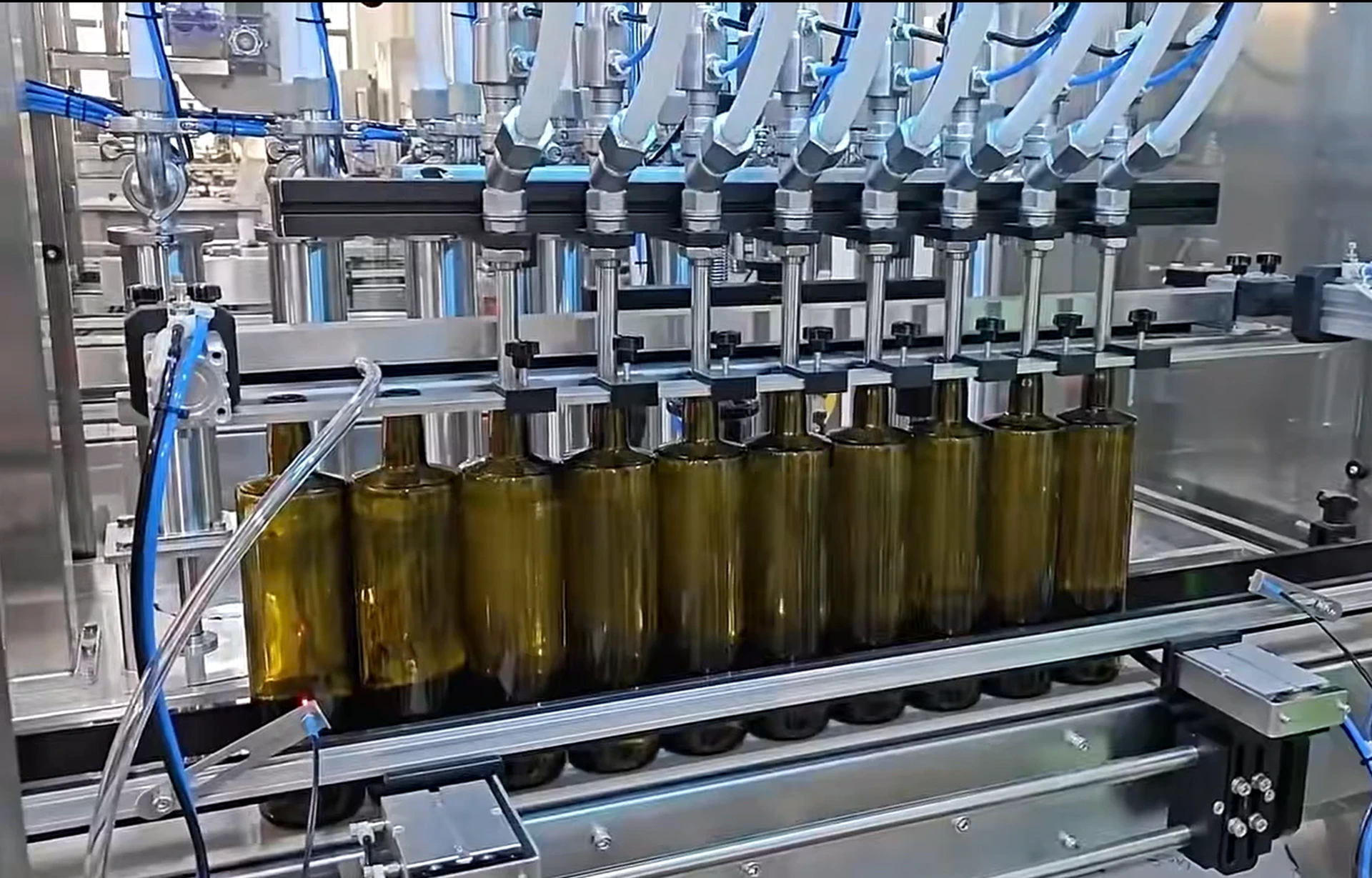
Caption: A bottom-up nozzle rises with the level, removing the drop height that creates most foam at the bottle neck.
A 2-second settling window applies to every bottle, so a 60 BPM filler with a 1.5-second capping cycle and a 2-second settle runs near 17 BPM, covered in Section 6. This is why home care filling line issues look like speed complaints.
Overflow filling locks a visible level for clear bottles, but it controls level, not weight. A dive nozzle with a slow-fast profile suits mid-viscosity foamy products. For the product-specific configuration, see the detergent and dishwashing liquid filling lines application page.
Where foam appears, why it forms and the risk of leaving it unfixed.
Foam Location | Root Cause | Countermeasure | Risk If Ignored |
Free fall from nozzle | Drop height traps air | Bottom-up dive nozzle | Short net content, false full |
First second surge | Fast start aerates product | Slow-fast-slow profile | Neck contamination |
Splashing return line | Return above liquid level | Submerge return below level | Persistent tank foam |
Vortex in buffer tank | Pump draws air | Baffle or lower pump speed | Entrained air, unstable dose |
Foam under closure | No settling window | Add dwell before capping | Capper slip, label lift |
Case Study A: Foam Rejects on a Dish Soap Line (Composite Example)
Composite case study. Details adjusted. Not a performance claim for a Runtech machine.
Background: A 250 ml PET dish soap line with a partial-surfactant formulation.
Challenge: Foam at the neck drove rejects to around 15%, with bottles wiped by hand before labelling.
Solution: A bottom-up dive head, a profiled fill stroke, a settling window, and stable tank level and temperature.
Results: Rejects fell to about 2%, manual wiping stopped, and effective throughput rose from roughly 20 to 30 BPM.
3. What Causes Nozzle Dripping, Stringing and Dirty Bottle Necks?
Drip is a cut-off problem that becomes a labelling problem. After the dose, residual pressure pushes product out of the nozzle. On thin detergents it drips, on gels it strings, and either way the neck and thread are contaminated. Stop the drip at the end of the stroke. On a detergent line, the cut-off profile sets the residue on the neck.
Four mechanical causes recur: suck-back not enabled or too weak, a worn or clogged nozzle seal, residual line pressure at the end of the stroke, and a nozzle that lifts before the liquid clears the tip. A fifth is maintenance related, product film cures during a stop and drips on restart. Published guidance puts viscous products in the 1,000 to 50,000+ cP range needing positive displacement, dive nozzles and anti-drip cut-off.
Residue on the neck causes capper slip, wrong torque readings and labels lifting at one corner. A line can pass a fill check and still fail at capping.
Ask for suck-back with a timed retract, an anti-drip valve, a slow final stroke on viscous products, delayed nozzle lift, and nozzle reach matched to the neck finish. Confirm all five on the real bottle, not a laboratory jar. For the viscosity spread that strings one SKU and foams the next, see the shampoo and hair conditioner filling line page.
Drip and stringing symptoms, mechanical causes, adjustments and verification.
Symptom | Mechanical Cause | Adjustment | Verification |
Single drip after each fill | Suck-back missing or weak | Enable timed retract | Weigh neck residue after 100 cycles |
Continuous weep between bottles | Residual line pressure | Add anti-drip valve | Inspect neck after dwell |
Stringing on gel | Cut-off too fast for viscosity | Slow final stroke | Check tip after pause |
Residue on thread only | Nozzle reach too shallow | Match reach to neck finish | Wipe test on thread |
Drip after line stop | Product film cures in line | Flush line on stop | Restart and inspect first bottle |
4. When Does Chemistry Start Eating the Machine?
Daily chemical is not one chemical family. Four groups change the specification: hypochlorite bleach, strong acid such as toilet cleaner, strong alkali such as degreaser, and high-surfactant concentrates that attack elastomers. A line quoted for detergent but built for soap fails on the first chlorinated SKU. This is the disinfectant filling machine corrosion question that typically arrives after damage.
Standard 304 stainless suits ordinary detergent and soap. Continuous hypochlorite duty needs a plastic wetted path in PVDF, PP or CPVC with PTFE seals, and 316L is defensible only for dilute intermittent contact. Acids need PVDF or PP-lined paths with PTFE.
Specify against the safety data sheet, not the word detergent, because published guides rate stainless as limited for continuous chlorinated duty. Figure 4 marks the point where the wetted path moves from 316L stainless to PVDF with matched PTFE seals.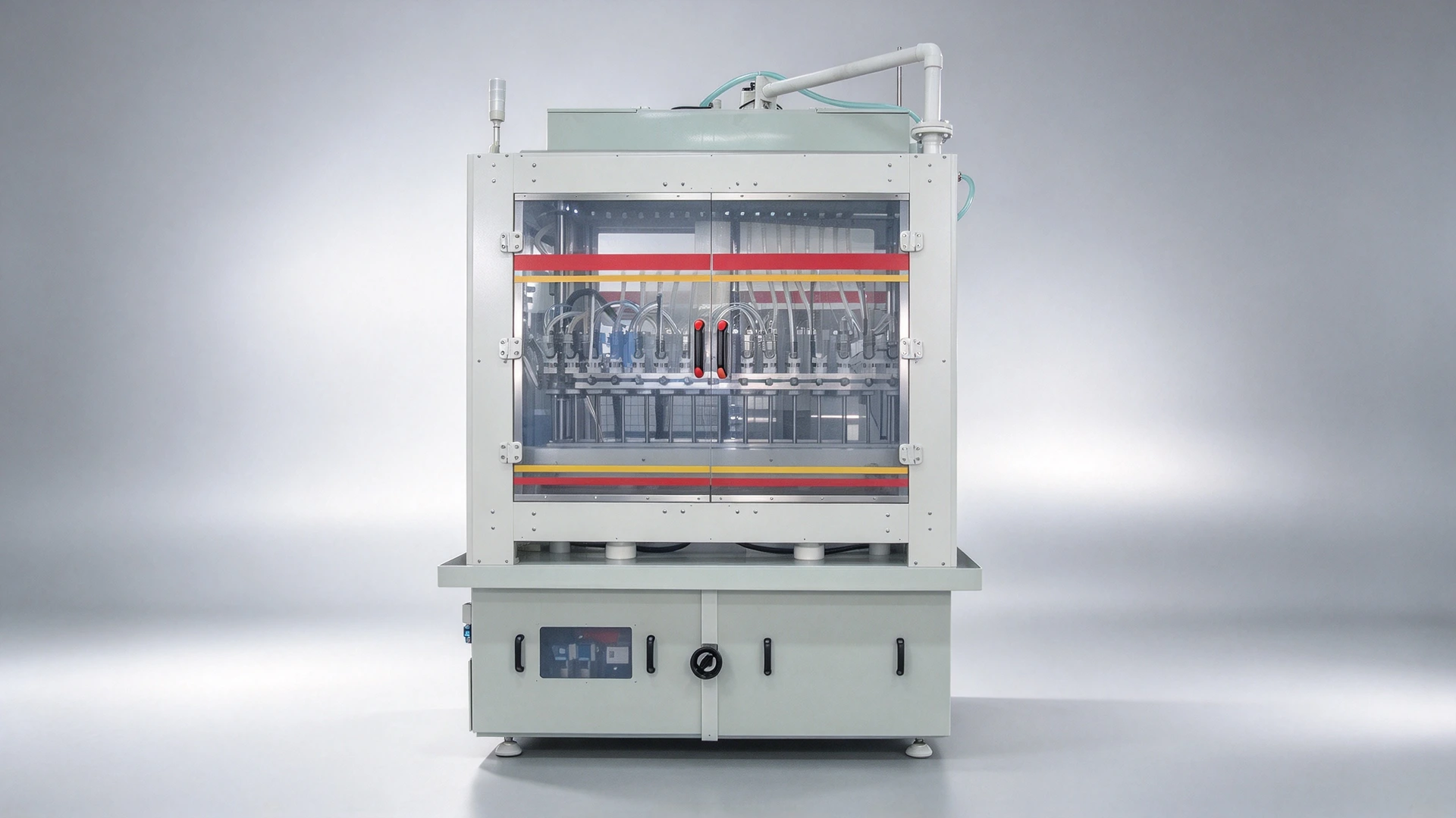
Parts nobody calls wetted still fail. Frames corrode from fume and splash, cabinets take vapour ingress. The acceptance list is a positive-pressure or IP66 cabinet, sealed conduit, drip trays and fume extraction from day one. CIP chemistry belongs in the same review.
EPDM suits caustic duty, Viton suits solvent blends, and PTFE is the universal fallback, with EPDM limited to roughly 6% NaOCl and below in published guidance. Confirm every seal against the safety data sheet. The product-specific choice is covered on the bleach and disinfectant filling lines page, where chemistry, not the marketing name, decides the wetted path.
Wetted path and seals by daily chemical product family.
Product Family | Wetted Material | Seal | Avoid | Filling Method |
Standard detergent, soap | 304 or 316L stainless | EPDM | Unnecessary 316L cost | Servo piston, gear pump |
Hypochlorite bleach | PVDF, PP or CPVC; 316L for dilute intermittent | PTFE; EPDM only below 6% NaOCl | 304 or 316L in continuous duty | Gravity, timed flow, net weight |
Strong acid cleaner | PVDF or PP lined | PTFE | Standard stainless, EPDM | Piston with plastic path |
Strong alkali degreaser | 316L stainless or PP | PTFE or EPDM | Aluminium, Viton in caustic duty | Gear pump, piston |
Hydrogen peroxide | 316L stainless or HDPE | PTFE or EPDM | Copper and brass contact | Gravity, overflow |
Solvent based cleaner | 316L stainless, PTFE lined | Viton or PTFE | Unrated elastomers | Piston, net weight |
Case Study B: Chlorinated SKU on a 304 Path (Composite Example)
Composite case study. Details adjusted. Not a performance claim for a Runtech machine.
Background: A home care producer ran a chlorine-based disinfectant through a 304 stainless wetted path.
Challenge: After months of service the flow path showed pitting, and seal life collapsed on the same SKU.
Solution: The team reviewed the safety data sheet, moved to a PVDF and 316L wetted path with matched seals, and added fume extraction.
Results: Pitting stopped and the line returned to stable production. The fix came from the SDS review and seal selection, not a machine swap.
5. Why Does Changeover Eat a Whole Shift?
Changeover is not the exception in daily chemical production; it is the operating mode. A typical plant runs 10 to 50 SKUs across viscosity, colour, fragrance and bottle format. One reported filling line changeover time figure hides two jobs.
Split the number before reducing it. Product-contact cleaning means drain, flush, wash, inspect and reassemble. It is chemistry work driven by the transition. Bottle-format setup means guides, star wheels, nozzle height and torque recipe. That is mechanical work driven by how far apart the formats are. Cleaning improves with dedicated contact-part sets. Format setup improves with saved recipes and tool-free parts.
Sequence beats speed. Dark to clear is not the burden of clear to dark, and a strong fragrance before a neutral SKU differs from the reverse. Published supplier guidance puts light same-family changeover near 20 minutes and full chemistry-different changeover near 45 to 60 minutes including validation, with format-only changes around 30 to 45 minutes using tool-free parts. Treat these as indicative claims and build your own transition matrix.
A line at 40 BPM losing 25 minutes per changeover three times a shift loses 75 minutes, roughly 3,000 bottles, about 12% of an eight-hour shift that nobody invoices.
A changeover task clock, with the levers that shorten each step.
Changeover Task | Typical Time | Can It Be Reduced | How |
Drain and isolate | 5 to 10 min | Yes | Quick-release connections |
Clean and inspect | 15 to 30 min | Partly | Dedicated contact part sets |
Wait for parts or approval | 5 to 20 min | Yes | Stage parts, pre-approve first fill |
Reassemble | 5 to 10 min | Partly | Saved HMI recipes |
Format setup | 20 to 30 min | Yes | Tool-free guides, marked positions |
First good fill check | 5 to 10 min | Partly | Test hardest SKU first |
6. Why Is the Line Slower Than the Filler's Catalogue Rating?
Buyers conflate three numbers. Mechanical rate is what the filler does in isolation. Process-limited rate is what the product allows once foam and settling count.
Line-sustainable output is what the line delivers per hour, averaged across changeovers. Only the third pays for itself, and the gap between first and third is where the cost hides.
Foam-limited takt The filler can dose faster than the bottle can be capped, because the foam head needs a settling window before the closure goes on. The line rate then equals the capping rate, and the settling window is a fixed cost on every bottle.
Closure-limited takt Torque verification and orientation checks add fixed seconds per bottle. A pump cap or a trigger cap can be slower than a plain screw cap on the same capper. The closure, rather than the filler, sets the ceiling.
Line output equals 60 divided by the slowest station cycle in seconds. A foamy 500 ml dish soap filled at one bottle per second meets a 1.5-second capping cycle plus a 2-second settle. The line runs at 60 divided by 3.5, about 17 bottles per minute, despite a 60 BPM filler.
Size the filler above target so the capping station becomes the constraint you can trade against. The handover condition has four parts: neck cleanliness, fill height, bottle position repeatability and cap presentation. A 2 mm off-centre bottle or a neck with residue can fail a good capper, which is why Sections 2 and 3 matter to output as much as pump size.
7. How Do You Keep Contamination and Net-Content Complaints Under Control?
Cross-contamination is a changeover problem with a compliance consequence. Dedicated contact-part sets between fragrance families and a documented cleaning protocol are standard. The protocol must name the transition, cleaning chemistry, contact time and first-good-fill check, because a verbal handover does not survive a shift change. This is where daily chemical filling line troubleshooting stops being mechanical.
Net content is the other half. On weight-declared products, verify net content per bottle or use inline checkweighing with closed-loop correction. Manual checkweighing slows the line and adds scale fatigue drift. Published supplier claims put checkweigher feedback around ±0.2% on retail bottles, an indicative figure needing confirmation on your product.
Run the sample test on the hardest SKU: the most foaming liquid, the thickest gel and the most awkward neck, each in the production bottle and closure. A laboratory jar forgives what a retail neck does not.
Forward this input checklist internally:
- Product parameters: liquid or gel, viscosity at filling temperature, density, foam tendency, pH and whether the product carries particles.
- Bottle drawings: neck finish, capacity and fill height, with the real retail closure supplied as a sample.
- Target capacity: bottles per shift measured at the line, not the catalogue rate.
- Fill volume range: minimum and maximum dose per SKU, including the largest drum format.
- Capping method: screw, pump, trigger or flip-top, plus any closure orientation requirement.
- Workshop conditions: utilities, floor space, cleaning chemistry and any market certification required.
Recommended Filling Machines by Industry
Detergent and dishwashing lines: the configuration in Section 2 pairs a dive nozzle with suck-back cut-off and a saved recipe per SKU. See the application page linked earlier.
Shampoo, conditioner and lotion lines: Sections 3 and 6 cover the viscosity spread and the closure handover. A low-shear pump and a saved profile per SKU are the non-negotiables.
Broad daily chemical lines: the automatic servo-controlled filler and capper for daily chemical production lines combines servo dosing with capping in one station set, which removes most of the handover problems described in Section 6.
Frequently Asked Questions
1.Can one filling machine handle detergent, shampoo and thick gel detergent?
Yes, with a positive-displacement filler, a recipe per SKU and the right nozzle set. The limits are the thickest SKU and the narrowest neck, so sample both before purchase.
2.Why does my detergent filling machine foam so much, and how do I stop it?
Air entrapment plus surfactants is the cause. A bottom-up dive nozzle, a slow-fast-slow profile, a settling window and a stable tank level attack the sources. See Section 2. The same approach applies to shampoo filling machine foaming.
3.How do I stop filling machine nozzle dripping on a detergent line?
Enable suck-back with a timed retract, use an anti-drip valve, slow the final stroke on gels and delay nozzle lift until the liquid clears the tip. Section 3 lists the causes.
4.Can one line fill shampoo and bleach, and what wetted parts do I need?
Yes, if the wetted path is specified for it. Bleach and hypochlorite need PVDF, PP or CPVC with PTFE seals, or 316L for dilute intermittent duty only.
5.What fill accuracy is realistic, and why does detergent filling line accuracy drift after a few months?
Suppliers typically quote ±0.5% for servo piston and ±1% to 1.5% for gravity or overflow. Drift usually comes from seal wear, feed-level variation or temperature change, not the original setting.
6.How long does a product changeover take on a multi-SKU daily chemical line?
Published supplier guidance puts light same-family changeover near 20 minutes and full chemistry-different changeover near 45 to 60 minutes including validation. Format-only changes run around 30 to 45 minutes with tool-free parts. Your transition matrix is the number that coun