
Last spring, a skincare brand owner from Poland emailed us two samples of the same hand cream, one from her current line and one thicker winter formula. Her question was short: "Can one machine handle both?" That question sits at the heart of nearly every purchase we see, and it is exactly what this guide answers.
If you are comparing suppliers, you already know how hard it is to turn viscosity charts and speed tables into a confident choice. Demand for filling machinery keeps climbing across food, pharma, and personal care. Grand View Research projects the global filling machine market to reach USD 12.72 billion by 2030. That means more suppliers to compare, and more ways to get the specification wrong.
Most buyers arrive with a viscosity chart and a price target. Only one of those decides the machine.
Key Takeaways
- Filling machine applications by industry concentrate in five sectors: cosmetics, food and beverage, pharmaceuticals, lubricants, and household chemicals.
- Product viscosity decides the filling method: gravity for thin free-flowing liquids, piston for creams and pastes, overflow for foamy or level-critical products.
- Typical upgrade projects pay back in 12 to 18 months, based on the capacity profiles below.
- Servo-driven piston fillers routinely deliver filling accuracy of ±0.5% to ±1%.
- Sending a product sample plus your target output lets our engineers return a machine recommendation within 24 hours.
1. Filling Machine Industry Applications: What Industries Use Them Most?
Five sectors account for most filling machine industry applications: cosmetics and personal care, food and beverage, pharmaceuticals, lubricants and chemicals, and household chemicals.
Wherever liquid or paste meets a container, a filling machine is doing the work. What separates these five sectors comes down to two things: viscosity and hygiene.
Cosmetics brands fill lotions, serums, and shampoos. Food producers run sauces, honey, oils, and beverages down their lines. Pharmaceutical plants demand precision filling for syrups and oral liquids. Lubricant packagers handle motor oil from 100 ml bottles up to 5 L jugs. Household chemical makers fill disinfectants and laundry liquids that often need chemical-resistant wetted parts.
Industry | Typical Products | Recommended Machine | Filling Method |
Cosmetics & personal care | Lotion, cream, shampoo, toner | Piston or overflow filler | Volumetric or level filling |
Food & beverage | Juice, sauce, honey, cooking oil | Gravity, piston, or overflow filler | Volumetric or level filling |
Pharmaceutical | Syrup, oral liquid, tincture | Peristaltic or servo piston filler | Volumetric, sanitary design |
Lubricants & chemicals | Motor oil, grease, detergent | Servo piston filler (EX-proof option) | Volumetric |
Household chemicals | Disinfectant, laundry liquid | Piston or overflow filler | Volumetric or level filling |
Across all bottle filling machine uses, one pattern holds: the machine follows the material, not the industry label. A honey producer and a hand cream maker may both need a piston filler, while a water bottler and a toner producer both suit overflow filling.
2. Which Filling Machine Suits Cosmetics and Personal Care Products?
If you are choosing a liquid filling machine for cosmetics, the split is simple. Thin, foamy products like toner and micellar water suit overflow filling, which guarantees a visually identical fill level on every transparent bottle. Thicker products like cream, lotion, and sunscreen need piston filling, which pushes precise volumes of viscous material through the nozzle.
A paste filling machine with a heated hopper adds another layer of flexibility. It keeps shea butter or waxy balms flowing in winter, then switches back to room-temperature products without changing nozzles.
That was the answer we sent back to Poland: one piston filler with a heated hopper covers both formulas. Recipe memory stores each viscosity, so switching seasons is a button press, not a nozzle change.
Case Study: Hand Cream Line Upgrade, Poland Background: A mid-size skincare brand producing 40 ml and 75 ml hand cream tubes and bottles.
Challenge: Their semi-automatic bench filler ran at about 150 bottles per hour, demanded four operators on filling alone, and varied by as much as ±3% between operators.
Solution: One automatic piston filling machine with a heated hopper, paired with an automatic capping machine and conveyor.
Results: Output rose to 450 bottles per hour, staffing on filling dropped from four operators to one, and accuracy settled at ±1%. With the complete line priced in the mid five figures (USD), it paid for itself in about 14 months.
"We stopped hiring seasonal workers just to keep up with Christmas orders," the production manager told us. "The line now finishes the winter batch before lunch."
A note on the numbers: the profiles in this guide are composite examples based on typical project outcomes. They show what a well-specified line can do, not what yours will do. Your demo test is the number that counts.
3. How Are Filling Machines Used in Food and Beverage Production?
Food and beverage is the broadest of all filling machine applications by industry, because materials range from water-thin juice to peanut butter. Hygiene drives the specification: food contact surfaces in stainless steel 304 or 316, quick-release nozzles, and easy washdown design. Producers supplying dairy or beverage plants often reference 3-A Sanitary Standards to align their equipment with North American expectations, while European buyers usually ask for EHEDG compliance instead.
Case Study: Chili Sauce Line, Southeast Asia Background: A condiment manufacturer bottling chili sauce with visible chili seeds in 250 ml and 500 ml glass bottles.
Challenge: Their gravity filler clogged on particulates, and operators scraped sauce by hand twice per shift.
Solution: A servo piston filler with an enlarged valve and particulate-safe nozzles, plus a rotating brush tank for the product reservoir.
Results: Output climbed from 900 to 2,640 bottles per hour, product giveaway fell by 2.1 percentage points thanks to ±0.8% accuracy, and one operator now manages the filling station end to end.
"We used to scrape the tank by hand twice a shift," the plant supervisor said. "Now the only scraping happens at cleaning time."
Food Material | Viscosity / Character | Recommended Machine | Key Feature |
Fruit juice, flavored water | Thin, free-flowing, foamy | Overflow filler | Consistent visible fill level |
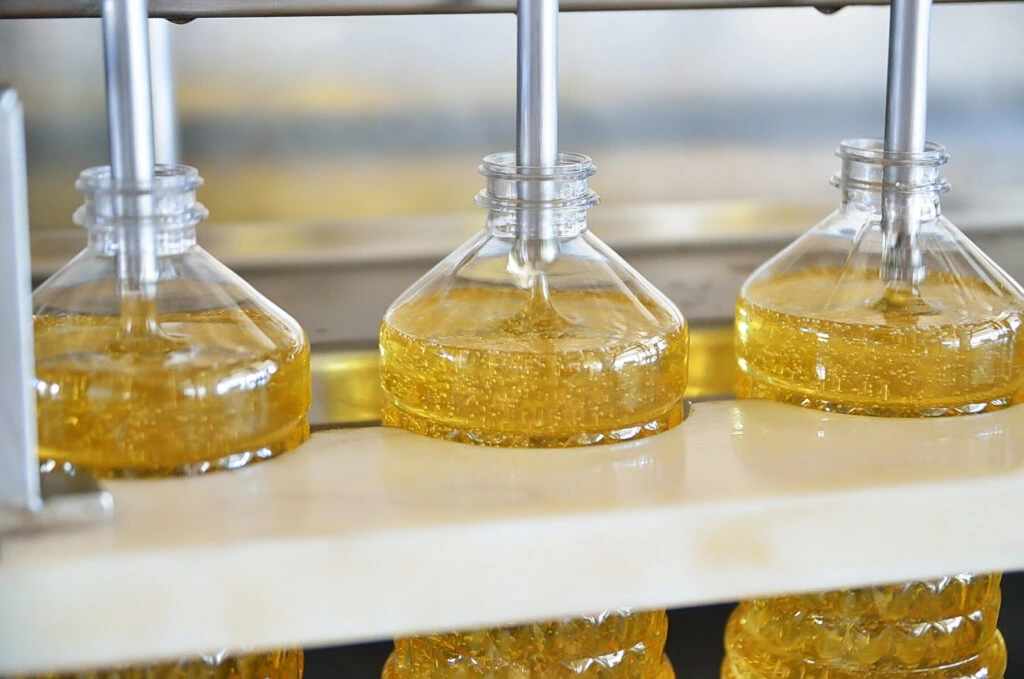
Cooking oil | Medium, slippery | Gravity or piston filler | Drip-free nozzle |
Honey | Very thick, temperature-sensitive | Piston filler with heated hopper | Jacketed hopper keeps honey flowing |
Chili sauce, jam | Thick with particulates | Piston filler, large-bore valve | Particulate-safe nozzles |
Vinegar, soy sauce | Thin, acidic | Overflow or gravity filler | 316L stainless wetted parts |
Hygiene details like these are non-negotiable, whether you fill sauces or beverages. Ask any supplier to confirm the wetted-part materials and the cleaning procedure in writing. For thin oils the nozzle, not the pump, decides whether the line drips, which is why edible oil filling machine nozzle options covers 2, 4, 6, and 8-nozzle configurations separately.
4. What Do Pharmaceutical Filling Lines Require?
Pharmaceutical filling raises the bar on three fronts: precision, hygiene, and documentation. Regulators expect compliance with FDA current Good Manufacturing Practice (cGMP), which influences everything from machine surface finishes to batch record keeping.
In practice, that means servo-driven dosing with accuracy of ±0.5% or better, sanitary tri-clamp connections, quick disassembly for clean-in-place routines, and full material traceability. Which of the two dosing routes you take changes both the tolerance you can hold and the maintenance calendar, as compared in servo versus piston dosing selection. Many buyers also request 316L contact parts and peristaltic filling for sterile liquids, because the product only ever touches the tubing.
A contract manufacturer in the Middle East had been filling 30 ml herbal oral liquid vials for a regional pharmacy chain with manual equipment. Every audit season, the same two findings came back: inconsistent volumes and missing fill-weight documentation. The fix was a compact servo piston monoblock that fills and caps on one frame and logs every fill cycle. Accuracy moved to ±0.5%, throughput settled at 40 vials per minute, and the next customer audit passed without a single filling-related observation.
If pharma is your sector, treat documentation as part of the purchase. IQ/OQ support and calibration certificates belong in the contract, not in a follow-up email after delivery.
5. Can One Filling Machine Handle Lubricants and Chemicals?
Yes, with the right specification. Lubricants, greases, and industrial chemicals bring three challenges: high viscosity, flammability, and corrosion.
High viscosity calls for a servo piston filler sized for the material, often with a heated or pressurized product path so thick oil reaches the nozzle at speed. Where density drifts between batches, net-weight dosing is the alternative, and piston or weighing dosing for thick liquids sets out which one wins on your product. Flammable products may require explosion-proof motors and controls in the filling zone. Corrosive cleaners call for PTFE or PVDF wetted parts that survive years of exposure.
Case Study: Lubricant 1 to 5 L Line, South America Background: A lubricant blender packing motor oil into 1 L, 4 L, and 5 L containers on the same line.
Challenge: Changeovers between container sizes took two hours, and the old filler flooded 5 L jugs while underfilling 1 L bottles.
Solution: An automatic servo piston filling machine with recipe-stored parameters for all three sizes and a four-head configuration.
Results: Changeover fell from two hours to fifteen minutes, output reached 800 containers per hour, and accuracy held at ±0.5% across every size.
"Nobody schedules a whole morning for a size change any more," the operations lead said. "Two of us do it while the other line keeps running."
One more reason to plan chemical and lubricant lines carefully: a single filler that handles three container sizes protects you from buying a second machine later. Recipe memory and a wide nozzle adjustment range are worth confirming on the very first call.
6. How Much Capacity Do I Need? Capacity Profiles by Fill Volume
Capacity questions are really fill volume questions. A filler running 30 ml vials and one running 5 L jugs live in different speed worlds. We cover the math in our guide on filling machine capacity by fill volume and in this comparison of linear vs rotary filling machine layouts. The short version: smaller volumes fill faster per cycle, but bottle handling often becomes the real bottleneck.
Three profiles answer almost every capacity question we get:
Case A: 30 ml Serum Line, Domestic Market A beauty startup moving from hand filling to its first automatic line chose a small rotary filler. Output went from about 600 to 2,400 bottles per hour, accuracy ±0.5%, one operator.
Case B: 250 ml Juice Line, Regional Brand A juice producer chose rotary over linear once weekly volume passed 100,000 bottles. Output rose from 1,500 to 3,600 bottles per hour, with consistent visible fill levels and ±1% accuracy.
Case C: 5 L Industrial Cleaner Line, Contract Packer A contract packer needed slow, accurate heavy fills, not speed. A two-head servo piston filler delivered 20 containers per minute at ±0.8% accuracy, which matched their palletizing pace perfectly.
Case | Industry | Product | Fill Volume | Output Before → After | Accuracy |
A | Cosmetics | Face serum | 30 ml | 600 → 2,400 bottles/hr | ±0.5% |
B | Food & beverage | Fruit juice | 250 ml | 1,500 → 3,600 bottles/hr | ±1% |
C | Household chemicals | Industrial cleaner | 5 L | 500 → 1,200 containers/hr | ±0.8% |
Use these numbers as orientation, then test with your own product. Two liquids with identical viscosity can behave differently when the same pump accelerates them, which is why we recommend validating industrial filling machine solutions on a demo line with the customer's product before shipment. That sample test is the cheapest insurance you can buy.
Want to see where your product fits? Send us a sample and target output, and we will run the numbers before you commit.
7. What Information Should You Prepare Before Requesting a Quote?
Search "how to choose a filling machine for my product" and you land on the same six answers every time:
- Product parameters: liquid or paste, viscosity (in cP or mPa·s if you have it), density, temperature sensitivity, and whether it contains particles or fibers.
- Bottle drawings: shape, height, diameter, neck finish, and material (glass, PET, HDPE).
- Target capacity: realistic bottles per hour or per shift, including your planned growth over two years.
- Fill volume range: single volume or multiple sizes, which decides whether you need recipe memory.
- Capping method: screw cap, snap cap, pump, or spray head, since each one needs a different capper setup.
- Workshop conditions: available power supply, compressed air pressure, floor space, and any explosion-proof zoning requirements.
Buyers who send all six items in the first email typically receive a full recommendation and layout drawing within one working day. Buyers who send only "price for a filling machine" often wait days while we ask questions back and forth.
8. How Do You Avoid Common Filling Machine Selection Mistakes?
Four mistakes show up in almost every pre-purchase review we run. Avoiding them saves more money than any discount ever will.
Mistake 1: Choosing a gravity filler for viscous products. Gravity filling depends on the liquid flowing freely. Creams, honey, and heavy oils will dribble, drip, and never reach volume accuracy. Piston or servo filling is the answer for anything you would describe as "thick."
Mistake 2: Comparing peak speeds instead of effective capacity. A brochure may claim 100 bottles per minute, but that number assumes perfect bottles, zero changeovers, and no stops. Ask for effective output with your bottle and product, not the headline speed.
Mistake 3: Ignoring changeover time. If you run four SKUs daily, a machine that needs two hours to switch between sizes quietly loses 25% of your shift. Recipe-stored parameters and tool-free adjustments turn changeover from a project into a routine. If you change product more than twice a shift, read multi-SKU changeover planning before you approve the layout.
Mistake 4: Overlooking bottle stability. Lightweight PET bottles tip and wander on conveyors unless the machine grips or stabilizes the neck. Always test your actual bottles, especially the thinnest-walled ones, before approving the design.
Each of these mistakes surfaces during a proper product test. That is exactly why we ask for samples early in the conversation.
Recommended Filling Machines by Industry
Not sure which of our machines fits your line? Match your sector below:
Cosmetics and personal care lines: the Automatic Rotary Daily Chemical Filling Machine suits shampoo, lotion, and toner producers needing high-speed rotary filling. Built for weekly volume above 100,000 bottles across multiple SKUs.
Food and sauce lines: our piston-based industrial filling machine solutions for sauces and viscous foods handle particulates and heated products. Pick a chili sauce and tomato paste filling machine when sauce, honey, or paste clogs a conventional filler.
Lubricant and chemical lines: the servo piston filling equipment for 1 to 5 L containers covers oil, grease, and industrial liquids with optional explosion-proof configuration. Best fit when you pack several container sizes and change over daily, which is what our 1 to 5 L filling and capping line was built around.
Each machine page includes technical parameters, videos, and downloadable specs. If your application sits between two machines, say so in your inquiry, because hybrid configurations are often possible.
Frequently Asked Questions
1.Can one filling machine fill different products and bottle sizes?
Yes, if the machine is specified for that flexibility up front. Servo piston fillers store recipes for multiple fill volumes, and adjustable nozzle pitch handles different bottle diameters. The limits are viscosity range and container size span: one machine covers, for example, 50 ml to 1 L comfortably, but a 30 ml vial and a 5 L jug generally need two different fillers or a dual-range design.
2.What filling accuracy can I expect?
Expect ±0.5% to ±1% from a servo-driven piston or peristaltic filler, and roughly ±1% to ±2% from semi-automatic machines. Overflow fillers control level rather than volume, typically within ±1 mm of fill height. Your actual result depends on product consistency and bottle variation, so validate with your own material during a demo test.
3.How do I choose between gravity, piston, and overflow filling?
Let viscosity decide. Gravity filling suits thin, free-flowing liquids like water, vinegar, and alcohol. Piston filling suits creams, sauces, honey, oils, and anything viscous or containing particles, because it meters exact volumes mechanically. For thick products, choosing a viscous liquid filling machine goes deeper into hopper, valve, and heat decisions.
Overflow filling suits thin to medium liquids where a consistent visible level matters most, such as transparent cosmetic bottles. When in doubt between two methods, a sample test settles the question in minutes.
4.Do you provide installation, training and after sales support overseas?
Yes. We ship with installation manuals and video guides, and our engineers offer remote video commissioning as standard. For full automatic lines, on site installation and operator training can be arranged depending on your region. Spare parts packages ship with the machine, and our support team responds within one working day, in English.
5.How long is the lead time for a custom filling line?
Standard machines typically ship in 15 to 30 working days after deposit. Custom lines with non-standard nozzles, explosion-proof configuration, or special wetted materials usually need 30 to 45 working days, plus sea freight time to your port. We confirm the exact schedule in the quotation, and every machine passes a full factory acceptance test with your product samples before packing.