
1. Quick Answer: Which Industries Run Rotary Cappers, and at What Output?
A rotary capping machine applies caps on a rotating turret, handling stable bottle shapes and large batches with ease. Typical output ranges from 80 to 400 BPM. Here is how different industries use them:
Table T1 — Industry quick reference
Industry | Typical Bottle & Cap | Speed Range (BPM) | Why Rotary Fits |
Daily chemical | HDPE/PET bottle, trigger spray or pump cap | 100–250 | Cap orientation + parallel heads for volume |
Cosmetics | Glass/acrylic bottle, small lotion pump | 60–150 | Servo torque control, gentle chuck pads |
Food | Glass bottle/jar, 38 mm screw cap | 120–200 | Consistent torque for seal integrity |
Pharma | Oral liquid bottle, aluminum-plastic cap | 60–120 | Torque traceability, reject station |
Agrochemical | HDPE 1–4 L, large-diameter screw cap | 60–150 | Anti-corrosion frame, high-torque heads |
Key takeaway: Choose a rotary capping machine when volume, cap orientation, or torque traceability — not just speed — drives your line. Browse the rotary capping machine range to see head configurations from 6 to 24.
2. Industry Applications: Five Verticals and What Changes Between Them
The turret principle stays constant across industries. What changes is the cap, the torque window, and the failure mode you must design out.
Daily chemical lines run trigger sprayers and pump caps on HDPE or PET bottles. Products foam, caps are bulky, and every cap must be oriented. The design problem is cap handling at speed.
Cosmetics lines handle small-diameter pump caps on glass or acrylic bottles where a single chuck scratch is a customer return. Torque is low and precise; servo-driven heads with soft gripper pads are the answer.
Food lines cap glass sauce bottles with 38 mm screw caps. The enemy is inconsistent torque leading to leakers on retort or hot-fill products. Glass demands gentle but rigid bottle plates. If the filler itself is the constraint on viscous sauces, start with our guide to choosing a liquid filling machine for viscous products.
Pharma lines cap oral liquid bottles with child-resistant or aluminum-plastic caps under GMP. Every capping cycle's torque must be recorded, and under-torqued bottles rejected automatically.
Agrochemical lines cap 1–4 L HDPE containers with large-diameter caps containing aggressive formulations. Frames need anti-corrosion treatment, heads need higher torque, and downstream leak detection is standard.
Table T1 — What changes between verticals
Industry | Cap Type | Torque Requirement | Typical Speed | Failure Mode to Design Out |
Daily chemical | Trigger spray / pump cap, oriented | Medium, consistent | 100–250 BPM | Misaligned trigger, cross-threading |
Cosmetics | Small lotion pump | Low, precise (servo) | 60–150 BPM | Bottle surface scratches, pump leaks |
Food | 38 mm screw cap on glass | High, tightly banded | 120–200 BPM | Seal failure, glass breakage |
Pharma | Aluminum-plastic / CR cap | Traceable, documented | 60–120 BPM | Torque data gap in audit |
Agrochemical | Large HDPE screw cap | High, corrosion-proof build | 60–150 BPM | Cap leaks, frame corrosion |
3. Case Studies: Five Rotary Capping Machine Lines, Before and After
Let's look at how five different factories solved their capping bottlenecks. Note that the fix isn't always about buying a "faster" machine, but matching the right torque and handling to the bottle.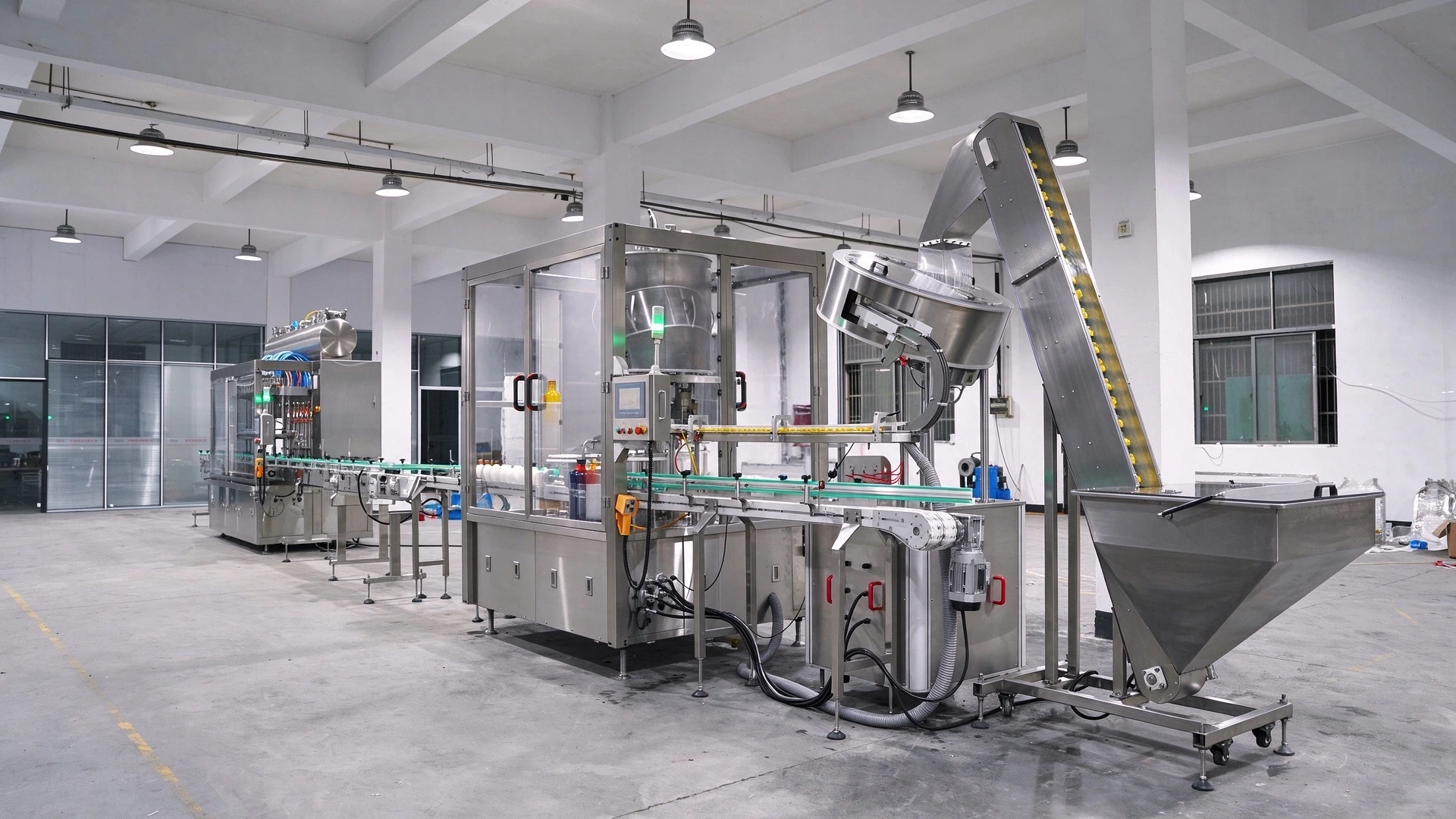
A matched filling–capping line: the capper has to be sized to the slowest upstream station, not the other way round.
Case 1 — Dishwashing liquid, trigger spray (Southeast Asia)
A dishwashing liquid producer in Southeast Asia ran two inline capping heads on a trigger spray line and capped out at 60 BPM while the filler could do 140. Four operators hand-tightened overflow bottles. The fix: an 8-head rotary trigger capper with a cap orientation elevator. Output rose from 60 to an estimated 180 BPM, manual labor dropped from 4 operators to 1, and the mis-capped rate fell from roughly 1.8% to an estimated 0.4%.
Case 2 — Cosmetics, lotion pump (East Asia)
A cosmetics contract manufacturer capped 30 ml lotion bottles on a semi-automatic bench capper at about 3,000 bottles per hour, with visible chuck scratches on premium acrylic bottles. We supplied an 8-head rotary pump capper with servo torque control and soft gripper pads plus cap orientation. Throughput reached an estimated 9,000 bottles per hour, and — per the client's line QC — surface scratches dropped to zero over the first review period.
Case 3 — Food sauce, glass bottle (Middle East)
A sauce producer's 12-head rotary capper could not keep pace with a 180 BPM filler; the capper capped out around 120 BPM and the buffer emptied and starved in waves. We re-specced to a 12-head rotary with a wider turret pitch and heavier-duty bottle plates for glass. The line now runs an estimated 180 BPM end-to-end. The cost of unblocking the line: about 1.2 m of extra floor length for the larger turret and star wheels.
Case 4 — Pharma, oral liquid (EU market)
An oral liquid producer faced a GMP audit demanding torque traceability for every capped bottle. Their inline capper kept no records. We installed a 6-head rotary capper with per-head torque logging, data export, and an automatic under-torque reject station. The audit passed; output roughly doubled versus the old station at the same staffing, with torque data now part of the batch record. The logging and audit-trail functions are designed to align with 21 CFR Part 11 electronic records requirements.
Case 5 — Agrochemical, HDPE 1 L / 4 L (Latin America)
An agrochemical producer took leak complaints on 1 L and 4 L HDPE containers with large-diameter caps. The old inline capper could not hold torque on flexible containers. The fix: an 8-head rotary built on an anti-corrosion frame, high-torque heads, and a downstream seal check station. Leak rate fell below an estimated 0.05%, and warranty claims for leaking containers dropped to near zero in the following season. UN-certified packaging requirements for such containers are governed under UN packaging requirements for dangerous goods.
Table T2 — Case summary
Case | Industry | Bottle & Cap | Change (Before → After) | Output Change | Labor Change |
1 | Daily chemical | PET bottle, trigger spray | 2-head inline → 8-head rotary + orientation | 60 → 180 BPM | 4 → 1 operators |
2 | Cosmetics | 30 ml acrylic, lotion pump | Semi-automatic → 8-head rotary, servo torque | 3,000 → 9,000 bph | Same, reallocated |
3 | Food | Glass bottle, 38 mm screw | Undersized 12-head rotary → wider pitch, heavy-duty plates | 120 → 180 BPM | No change |
4 | Pharma | Oral liquid, Al-plastic cap | Inline, no records → 6-head rotary + torque log + reject | ~2× | No change |
5 | Agrochemical | HDPE 1–4 L, large cap | Inline capper → 8-head rotary anti-corrosion + leak check | Same speed, leak <0.05% | No change |
Case Insights: In every single case, capping was the bottleneck, not filling. The root cause was either too few capping heads or uncontrolled torque. Estimated payback across the five cases ran 12–20 months—fastest where throughput alone drove the gain (Case 3), slowest where validation and documentation joined the scope (Case 4).
4. What the Five Cases Have in Common: Head-Count Sizing
Sizing a rotary capping machine: divide your target sustained BPM by realistic per-head output — about 20 BPM per head for pump caps and 25 BPM for screw caps at 80% OEE. A 150 BPM screw-cap line needs 6 heads; a 150 BPM pump-cap line needs 8. Add one head for growth.
Table T3 — Estimated output by capping head count
Capping Heads | Est. Theoretical BPM (pump cap) | Est. Theoretical BPM (screw cap) | Realistic BPM at 80% OEE | Suitable Line Scale |
6 | ~120 | ~150 | ~96–120 | Pilot to mid-size, 2 shifts |
8 | ~160 | ~200 | ~128–160 | Mid-size, 2 shifts |
12 | ~240 | ~300 | ~192–240 | Large, 2–3 shifts |
16 | ~320 | ~400 | ~256–320 | High-volume, 3 shifts |
24 | ~480 | ~600 | ~384–480 | Very high volume, 3 shifts |
(Values are estimates based on a 1.5–2.0 s single-head cycle; pump caps cycle slower due to orientation and pick geometry.)
Run the same math in the other direction: realistic output = head count × (60 ÷ single-head cycle seconds) × OEE.
Never size a rotary turret on its peak nameplate speed. Changeovers eat hours, cleaning eats minutes, and upstream fillers fluctuate. If your filler peaks at 200 BPM but averages 150, an 8-head capper at ~128–160 realistic BPM is already the constraint. Always add one extra head for growth—it is cheaper than adding a second shift.
5. Changeover Economics: What a Multi-Size Line Really Costs
Changing bottle or cap formats on a rotary machine typically means swapping the infeed star wheel, chuck pads, infeed screw, and cap chute. This costs an estimated $1,500–$5,000 per set and takes 2–6 hours including test runs.
The real cost is not the parts; it is the lost production time. A line running 40 changeovers a year at 4 hours each loses 160 production hours. On a 180 BPM line, that could risk $345,000 of margin annually—dwarfing the parts budget. Invest in recipe storage on the HMI and quick-release tooling to minimize this downtime.
6. When a Rotary Capper Is the Wrong Choice
A rotary capper is the wrong choice in three cases:
- More than 6 SKUs in batches under 4 hours. Changeover hours outrun the output gain.
- Unstable or exotic bottle shapes that rotate poorly on a bottle plate.
- Output targets below roughly 50 BPM, where an inline spindle capper delivers adequate speed at a fraction of the price with near-zero change parts.
Rule of thumb: Below 50 BPM or above 6 SKUs with sub-4-hour batches, stay inline. Between those extremes, the rotary capping machine's head count — not its price tag — decides the economics. If you cap both pump and trigger formats, the format comparison in pump cap vs trigger cap machine differences will sharpen the decision.
7. The RFQ Checklist: What to Send Before You Ask for a Quote
Vague RFQs get vague quotations with optimistic BPM numbers. Send these six items and you will get a capacity-matched proposal back:
- Bottle drawing with neck finish T-dimension, bottle height, ovality tolerance, and bottle weight.
- Cap type and target torque window (min/max, not a single number). For how target torque windows are measured, see ASTM D3474-23 torque meter calibration.
- Target sustained BPM, OEE, SKU count and changeovers per year — average rate, not peak; group SKUs by bottle/cap size family.
- Upstream and downstream equipment with rated speeds (filler, labeling machines, cartoner), plus site utilities: voltage/frequency, air pressure and consumption budget.
- Environment requirements: washdown, anti-corrosion, explosion-proof, cleanroom class.
- Acceptance criteria: which bottle and cap samples will be used at FAT, and what pass rate defines acceptance.
With those six items, a supplier can run the head-count formula against your real bottles insteadS of quoting a catalog speed. Send line data and samples via request a capacity-matched quotation — we will come back with a configuration and an honest output estimate.