
1. Match the Technology to the Bottle and Cap First
The fundamental rule of equipment selection is straightforward: the cap determines the technology, the bottle determines the machine sizing, and the industry dictates the build standard. Following this sequence eliminates most selection errors. The table below compares the four capping technologies you will typically encounter in daily chemical and packaging lines.
Capping Technology | How It Works | Best For | Typical Speed | Watch Out For |
Spindle (screw) capper | Bottles spin between rotating spindles to tighten the cap | Flat or standard screw caps on stable round bottles | 40–150 bpm | Tall or unstable bottles may wobble |
Servo-torque capper | Servo motor applies precise, programmable torque to the cap | Delicate caps, pump heads, and precise torque requirements | 30–150 bpm | Requires regular electronic calibration |
Rotary carousel capper | Continuous carousel with multiple heads for high-speed output | High-volume production lines with stable bottle formats | Up to 200+ bpm | Higher initial investment and footprint |
Pneumatic Capper | Compressed air drives the capping head for tightening | Explosion-proof environments or cost-sensitive setups | 30–80 bpm | Air pressure fluctuations can affect torque |
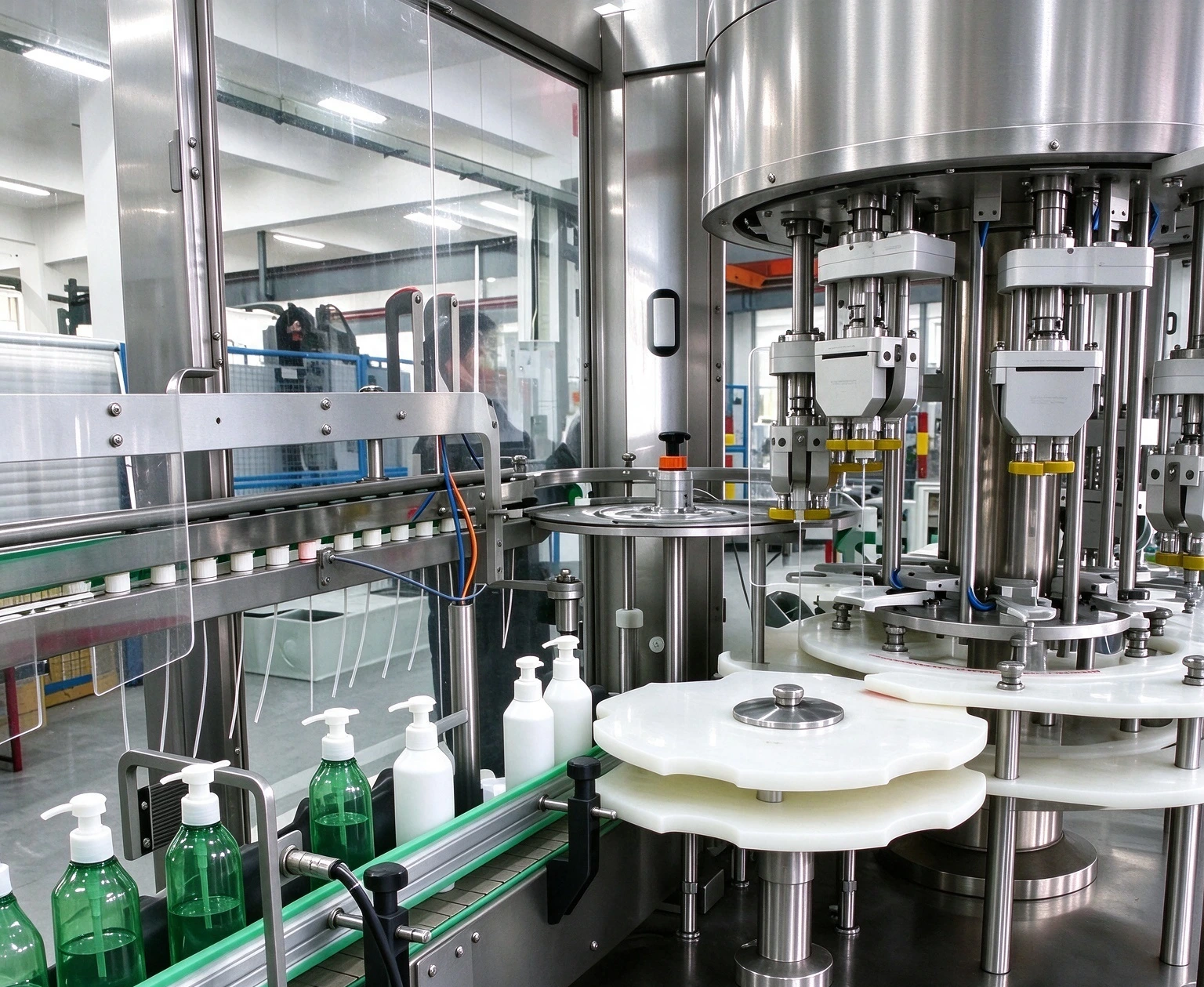
A servo-torque capping head operating over a rotary indexing plate — the configuration used in most of the cases below.
2. Industry Applications: Which Technology Fits Where
Different industries place distinct stresses on the same machine. Some prioritize hygienic design, while others demand extreme chemical resistance or absolute precision. This table maps the most common pairings we see across global engineering projects.
Industry | Typical Bottle & Cap | Matched Technology | Why It Works |
Food & Sauce | Glass jars, 38mm twist caps | Spindle capper + torque monitoring | Consistent torque stops cross-threading and ensures an airtight seal |
Pharmaceutical | Bottles with CRC or tamper-evident caps | Servo-torque capper with 316L build | Documented torque data supports GMP and FDA audits |
Personal Care | Pump heads, sprayers, disc-top caps | Servo-torque capper with gentle grip | Non-damage handling protects the delicate internal pump mechanism |
Agrochemical | HDPE bottles, chemical screw caps | Spindle capper with anti-corrosion build | Seal reliability when handling highly corrosive liquid products |
Lubricants & Chemicals | 1L to 4L style bottles, large caps | Rotary carousel or heavy-duty servo | Stable, high-torque handling of heavy and oversized containers |
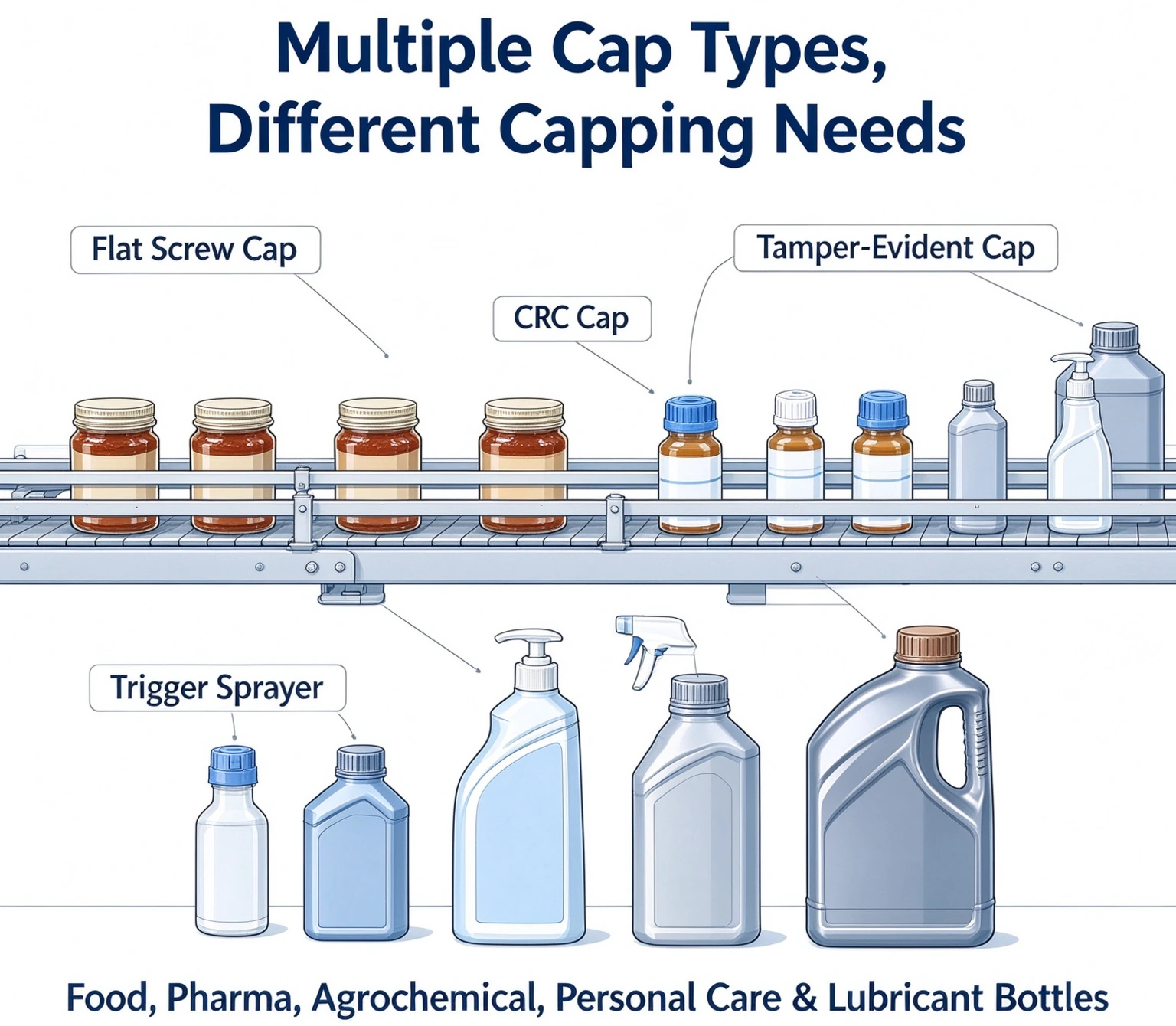
One line, many closure types: jars, small bottles and chemical containers each need their own torque and handling setup.
3. Core Components & Technology
Understanding the internal mechanics helps you evaluate equipment quality. Regardless of the type, a robust capping machine relies on three essential modules. First, a vibratory bowl or centrifugal feeder ensures caps are oriented correctly. Second, a bottle gripping mechanism (such as side belts or star wheels) securely holds the container to prevent spinning during torque application. Third, the capping head acts as the execution unit; whether mechanical clutch or servo-driven, it determines the final sealing precision. When investing in filling and capping line equipment, these core components dictate the machine's long-term stability and maintenance costs.
4. Common Capping Defects & Solutions
Even with the right technology, production issues can arise. Here is how to quickly diagnose the three most common capping defects.
Cross-threading: Usually caused by the cap not being level before torque is applied. Solution: Ensure the "soft start" profile is properly set and the cap chute is aligned perfectly with the bottle neck.
Leaking Caps: Often a result of insufficient torque or a damaged bottle thread. Solution: Verify the torque output with a torque tester and inspect the glass or plastic finish for manufacturing defects.
Skewed Caps: Typically caused by unstable bottles slipping during the capping cycle. Solution: Adjust the side gripper belts or replace worn star wheels to secure the container tightly.
For more troubleshooting tips, refer to our capping machine maintenance guide.
5. Real-World Customer Cases
Specifications tell you what a machine can do. Real-world cases show what a machine actually fixed. Here is how three distinct manufacturers solved their capping bottlenecks.
Case | Industry | Problem | Solution | Result |
Chili sauce producer | Food | 5% reject rate due to cross-threaded caps | Spindle capper + real-time torque monitoring | Rejects down to 0.1% |
Oral liquid plant | Pharma | Manual capping failed a strict GMP audit | Servo capper, 316L build + tamper-evident station | Passed audit; doubled throughput |
Agrochemical filler | Chemical | Leaking caps on HDPE bottles | Anti-corrosion capper + downstream seal check | Leakage below 0.05% |
Case Insights:In the food project, the root cause was an uncontrolled clutch torque. Upgrading to real-time monitoring, rather than buying a larger machine, solved the issue. In the pharma project, documented torque data was just as decisive as speed. In the chemical project, downstream verification caught defects that the capper alone could not detect.
6. Pre-Purchase Matching Checklist
Across all successful engineering projects, the following four checks are non-negotiable before placing an order:
- Confirm cap and bottle with real samples, not only drawings.
- Define the torque window and who verifies it on site.
- Decide hygiene or corrosion requirements by industry standard, not by habit.
- Plan the layout — infeed, outfeed and operator side — together with the machine; see the filling and capping line reference for integrated projects.
7. Start Your Project
Send us your bottle samples, cap specifications, and target speed. Our engineering team will confirm the optimal capping technology and configuration for your production line within one working day. You can also browse our automatic screw capping machine and rotary capping machine series for a first look at our capabilities.
Capping is decided by the cap, not the product. Viscous or foamy liquids still use spindle or servo-torque capping — the real risk is a dirty cap or bottle thread, which causes cross-threading and poor sealing. Clean the thread and set torque from real samples rather than from a formula.
Yes, within limits. Changeover parts — star wheels, grippers, cap chutes and torque recipes — can be made for two to four formats. Beyond that, changeover time and cost usually justify a second machine.
Servo-torque cappers typically repeat within ±5% of the set value; spindle cappers depend on clutch condition and drift more over time. Verification is done with a torque tester on sampled bottles, recorded per shift — this record is also what pharma auditors ask for.
Most leaks come from three causes: insufficient or excessive torque, a skewed cap, or a damaged bottle thread. Fix them in that order — verify torque first, then check cap centering, then inspect the bottle finish. Leak testing downstream is the only reliable confirmation.
For a standard automatic capper, typically 30–45 days from confirmed drawing to shipment, plus 3–5 days of installation and commissioning on site. Custom formats, stainless steel upgrades or integrated line projects add two to four weeks for design review.