
RUNTECH builds automatic capping machines for screw caps, trigger sprays, pump dispensers and flip-top closures, serving daily chemical, personal care, pharmaceutical and food packaging lines. The notes below consolidate the maintenance and troubleshooting questions our engineers hear most often during commissioning and after the first production shift.
| Subject | Capping defects Skewed, loose, stripped or cross-threaded closures. |
| Torque control | Servo or magnetic clutch Closed-loop torque matched to each closure spec. |
| Wear parts | Capping chuck and inserts Scheduled replacement consumables. |
| Maintenance | Daily, weekly and monthly checks Checklist detailed below. |
1.Why Capping Problems Surface in the First Place

Every capping head performs two tasks at once. It must center the closure squarely over the bottle mouth, and then rotate that closure to a specified torque without crushing the neck or cross-threading the threads. Let either task drift, and the line starts producing visible defects.
Centering drift typically comes from worn chuck inserts, a misaligned cap chute or a star wheel that no longer holds the bottle square. Torque drift typically comes from a slipping magnetic clutch, a servo parameter left over from the previous product, or a cap lot whose liner thickness has quietly changed between deliveries.
The relationship can be summed up as:
Capped Result = Centering Accuracy × Applied Torque × Closure Consistency
Any one of the three inputs drifting degrades the output. A perfectly tuned spindle on an off-center cap still delivers a skewed cap. A pristine closure on a worn clutch still delivers a loose or over-torqued seal. This is why effective troubleshooting always starts with the closure and the bottle, never with the motor.
| Root cause group | Typical visible defect |
|---|---|
| Closure not seated on the neck before spin | Skewed cap, side-seal rub marks, loose cap. |
| Torque set too high or too low | Stripped threads, leak after drop test, cap spins freely. |
| Chuck grip uneven or worn | Marked cap side, one-off missing cap, occasional skip. |
| Bottle or cap lot variation | Defect rate jumps right after a supplier change. |
2.Daily, Weekly and Monthly Maintenance Checklist
Preventive maintenance on a screw capping machine boils down to three jobs: keep the chuck clean, keep the cap path clear and keep the torque reference stable. The checklist below is drawn from RUNTECH commissioning records on customer lines.
| Interval | Check item | What to look for |
|---|---|---|
| Every shift start | Chuck grip and rubber insert condition | No product residue, no flattened or torn insert. |
| Every shift start | Torque spot check on five bottles | Within the closure supplier spec, no drift across the five samples. |
| Daily | Cap chute and elevator track | No jams, no upside-down caps piling up at the orienter. |
| Weekly | Spindle belt tension and coupling | No slack, no audible slip under load. |
| Weekly | Conveyor and star wheel alignment | Bottle sits centered under the chuck, no side rub on the guide rail. |
| Monthly | Torque re-verification against a calibrated meter | Displayed torque matches measured torque within tolerance. |
| Monthly | Pneumatic filter and oiler (if pneumatic lift) | Clean filter, correct oil level, no water in the air line. |
The list above is a baseline. Food, pharmaceutical and GMP environments typically add wash-down cycles, documented torque logs and a shorter chuck replacement interval.
3.Common Capping Defects, Likely Causes and First Fixes
Operators call the manufacturer about a specific defect far more often than they call about a vague fault. In most cases the answer is already visible on the line. The table below pairs each visible defect with the first three things to check, before any spare part is ordered.
| Visible defect | First check | Second check | Third check |
|---|---|---|---|
| Loose cap, leaks in drop test | Torque set too low on the HMI. | Magnetic clutch slipping from wear. | Cap liner thickness changed in the new lot. |
| Stripped or shaved threads | Torque set too high for the closure. | Chuck rotating before cap is seated. | Cap supplier thread pitch differs from sample. |
| Skewed or tilted cap | Cap not dropped straight onto the neck. | Chuck insert worn on one side. | Bottle neck not centered under the spindle. |
| Marks or scuffs on cap side | Chuck insert too tight for the cap diameter. | Spindle dwell time too long. | Cap material softer than the approved sample. |
| Missing cap on bottle | Cap chute empty or pick-off sensor blocked. | Orienter rejecting caps upside down. | Air pressure too low for the pick-off. |
| Intermittent skip, about one per minute | Worn chuck insert. | Loose coupling on the spindle. | Cap lot with mixed dimensions. |
One pattern is worth remembering: a sudden jump in defect rate almost always points to a consumable, such as the chuck insert, the liner or the cap lot, while a slow drift across weeks usually points to a mechanical wear part such as the clutch, the belt or the coupling.
4.Torque Control and Capping Chuck Care
 Two components of the spindle deserve more attention than everything else combined. The first is the capping chuck, the rubber or silicone insert that actually grips the closure. The second is the torque source itself, whether a magnetic clutch or a servo spindle.
The chuck is a wear part, not a permanent component
Chuck inserts touch every closure on the line. A high speed line can cap tens of thousands of bottles per shift. Over time the insert flattens, hardens or tears, and the first symptom is usually a closure gripped off center rather than one that is simply loose. Spare inserts should be stocked in the correct cavity size for every closure the line runs, and changed on a planned schedule rather than only after a defect is noticed.
Torque must match the closure spec, not the previous product
When a line switches from a 28 mm trigger spray to a 24 mm screw cap, the torque value has to be re-set. The closure supplier publishes a recommended application torque and a removal torque. The capping head should deliver the application torque within a tight tolerance, so that removal torque stays inside the seal window after settling. Carrying the previous product's torque over to the new closure is the single most common cause of stripped threads on a format change.
For lines that run frequent format changes, a monoblock filling and capping machine with servo spindles stores each recipe by product name, so the operator recalls the recipe instead of re-entering numbers by hand.
5.Matching the Maintenance Plan to the Closure Type
Not every capping head is maintained the same way. Screw caps, trigger sprays and pump dispensers place very different loads on the chuck and the spindle.
| Closure type | Typical industry | Maintenance focus |
|---|---|---|
| Screw cap (PP, HDPE) | Daily chemical, lubricant, food sauce | Torque stability, chuck insert wear, liner compression. |
| Trigger spray cap | Cleaning agents, garden chemicals, personal care | Cap centering, anti-theft ring engagement, chuck cavity shape. |
| Lotion pump and serum pump | Cosmetics, skincare, pharmaceutical | Dip tube alignment, over-cap seating, low torque to protect the actuator. |
| Flip-top and snap-on cap | Food, condiment, personal care | Press force, hinge orientation, snap-in sensor tuning. |
The rows above are a starting point. The actual torque window, chuck cavity and spindle speed should be confirmed against a sample bottle and closure before the maintenance schedule is frozen.
RUNTECH EQUIPMENT
Automatic Screw Capping Machine with Servo Torque Control
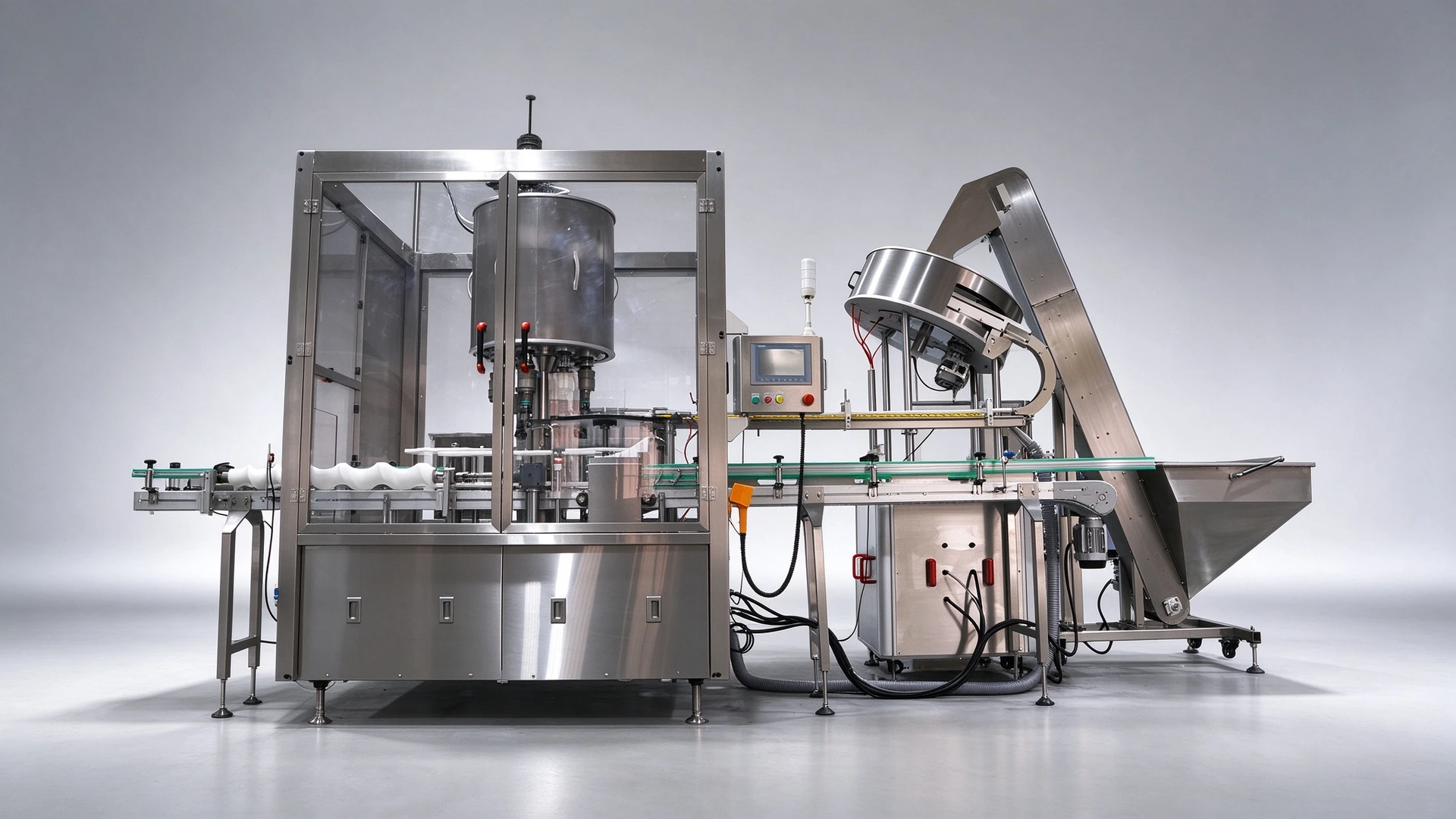
RUNTECH's automatic capping machine centers on a servo or magnetic-clutch spindle with quick-change chuck inserts. It handles screw caps, trigger sprays and pump dispensers, and links directly to filling, labeling and conveyor equipment to form a complete packaging line. Torque recipes are stored per product, and chuck inserts are stocked for every closure size the customer runs.
View the model that matches your closure range, bottle material and target line speed.
View This Automatic Capping Machine
The real question is not whether the capper can spin a closure. It is whether the chuck cavity, torque recipe and cap orienter are matched to your actual closure and bottle, under your actual production speed and shift pattern.
Questions before the next step
Two suppliers producing the same nominal closure can still deliver slightly different liner thickness or thread depth. The torque that worked on the previous lot may under-torque the new one. Run five sample bottles, measure removal torque, and adjust the spindle setting before releasing the full batch.
There is no fixed hour count. Inspect the insert at every shift start. Replace it once the rubber is flattened, torn or glossy, or once the line starts producing occasional skewed caps. Keep two spare inserts per cavity size on site.
Magnetic clutch cappers are cost-effective for a single closure type at moderate speed. Servo spindles earn their keep when you run frequent format changes, need torque data logging, or operate in GMP and pharmaceutical environments where every capped bottle must be traceable.
Most stripped-thread defects are a torque-setting issue, not a machine fault. Lower the application torque, confirm the closure supplier spec, and verify that the cap is seated on the neck before the spindle engages. If the defect survives those three checks, contact RUNTECH with sample bottles and closures.
With quick-change chuck inserts and a stored torque recipe, switching between two similar screw caps typically takes fifteen to thirty minutes, including the chuck swap, bottle guide adjustment and five-bottle torque verification. Moving between a screw cap and a trigger spray takes longer, because both the orienter chute and the chuck cavity must be changed.
Most RUNTECH cappers require a filtered, dried, oil-free air supply around six bar at the machine inlet. Pressure below five bar weakens the cap pick-off and the spindle lift, and shows up as missing caps or uneven seating. Confirm the exact consumption on the datasheet of the chosen model.
A steady motor hum under load is normal. A new rattle, a grinding sound or a sudden rhythmic knock usually points to a worn coupling, a loose belt or a dry spindle bearing. Stop the line, inspect the drive train, and contact RUNTECH if the source cannot be identified.
Spot-check five bottles every shift. Run a formal recalibration against a calibrated torque meter once a month, or after any chuck replacement, drive-train repair or major format change. Keep the records in the maintenance log for audit and GMP traceability.
NEXT STEP
Match your Closure and Bottle to the Right Capping Head
If you are evaluating a capping machine for a specific product, send the required closure type, bottle material, target line speed and any existing defect samples. These details let RUNTECH confirm the chuck cavity, torque window and orienter configuration before a quotation is prepared.